
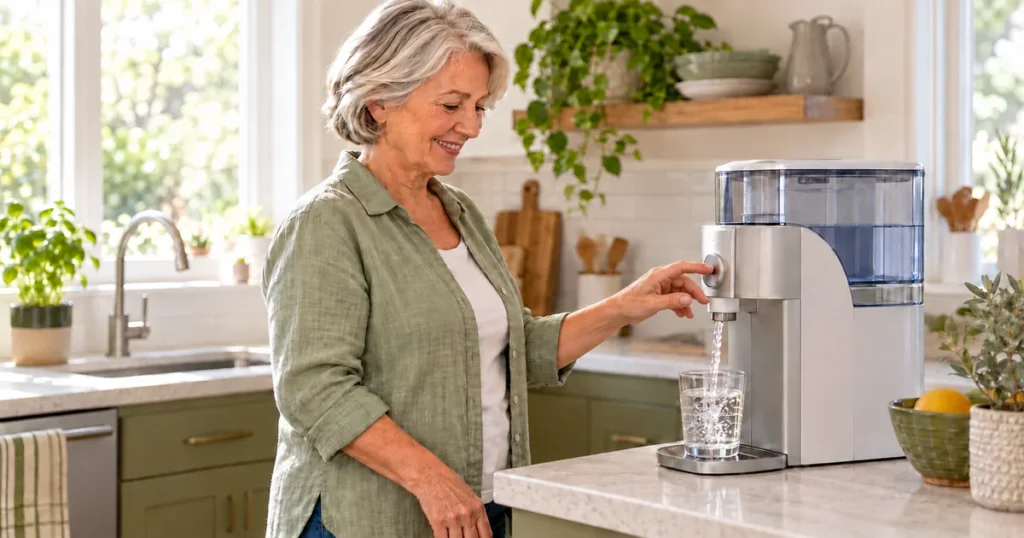
The best water filters for seniors should solve two problems together: address the household’s water concerns and make getting a glass of water manageable. A filter that looks impressive online can become frustrating if your parent must lift a full tank, read tiny indicators, or reach into a crowded cabinet every week.
This guide compares seven reverse osmosis systems available through Amazon, including countertop machines and permanently connected under-sink options. Countertop units avoid plumbing work, but their tanks still need refilling. Under-sink systems reduce that daily carrying, while installation and cartridge changes usually require more help. Neither format is automatically easier for every older adult.
Our recommendations are based on published product information and practical accessibility considerations, rather than personal laboratory testing. We look at dispensing, refill effort, controls, cleaning, replacement filters, and the support a household can realistically provide. The two Bluevua models are related but distinct: the standard ROPOT and the version with an additional UV stage.
Before purchasing, identify the specific substances you want to reduce and check the exact model’s certified claims. More filtration stages do not automatically make a product a better match. For an older parent, a clear maintenance plan can matter just as much as the machine itself.
Quick Picks
Best Overall Countertop Option: Bluevua RO100ROPOT
A no-plumbing system with a glass carafe and filter-life display. A useful starting point when a caregiver can help with refilling and washing.
Best for Dispensing Into a Cup: SimPure Y7P-BW
Direct countertop dispensing avoids pouring from a serving carafe. Check whether your parent can reach and refill the feed-water tank comfortably.
Best for Avoiding Daily Tank Refills: APEC ROES-50
A fixed under-sink system with a dedicated faucet. A practical choice when someone else can arrange installation and ongoing filter service.
Water filters for seniors comparison table
| Product | Type | Key features | Why it may help | Amazon |
|---|---|---|---|---|
| Bluevua RO100ROPOT | Countertop RO | Glass carafe; five-stage filtration; filter-life display | No plumbing; carafe and supply tank still require lifting | |
| SimPure Y7P-BW | Countertop RO with UV | Cup dispensing; selectable portions; replaceable cartridges | Reduces pouring from a pitcher, but needs tank refills | |
| APEC ROES-50 | Under-sink RO with tank | Five stages; dedicated faucet; 50 GPD rated production | No daily feed-tank carrying; allow cabinet space | |
| iSpring RCC7-BN | Under-sink RO with tank | Five stages; 75 GPD rating; clear first-stage housing | Familiar faucet use; cartridge service needs cabinet access | |
| Waterdrop G3P600, Black Faucet | Tankless under-sink RO | 600 GPD rating; faucet indicators; replaceable filters | No countertop tank refills; requires power and plumbing | |
| Bluevua RO100ROPOT-UV | Countertop RO with UV | Six-stage design; remineralization; glass carafe | An alternative to standard ROPOT when the additional stage is wanted | |
| Waterdrop K19-H | Countertop RO with hot water | Temperature selection; display; child lock | Useful for supported drink preparation; hot water adds handling demands |
GPD means gallons per day under specified test conditions. It is not a guarantee of the speed at your faucet. Water temperature, pressure, membrane condition, and the installed setup affect performance.
Detailed Reviews
1. Bluevua RO100ROPOT: A Straightforward Countertop Starting Point
The standard Bluevua RO100ROPOT combines countertop reverse osmosis with a borosilicate glass carafe, remineralization, and a filter-life display. It plugs into an outlet and does not require a connection to the kitchen plumbing. That makes it worth considering for a rental or a household avoiding cabinet alterations.
The important accessibility question is the carafe. Glass can be pleasant to serve from, but a full container adds weight and can break if dropped. Someone with painful fingers or an unreliable grip may prefer dispensing directly into a lightweight cup instead. The raw-water reservoir also needs attention between filtration cycles. Position the machine where the display is readable and both containers can be removed without reaching across a sink. Allow room above the unit for refilling, rather than measuring only its base. Keep the motorized base dry and follow the manufacturer’s tank-cleaning instructions.
Pros
- No permanent plumbing connection.
- Separate glass serving carafe.
- Display helps track cartridge service.
Cons
- Filled containers still need lifting.
- Glass requires careful handling and regular washing.
Best for…
- An older adult who can comfortably pour, with household help available for refills and maintenance.
2. SimPure Y7P-BW: Direct Dispensing Without a Serving Carafe
The SimPure Y7P-BW is a plug-in countertop reverse osmosis system with UV treatment and direct dispensing. Its cup-filling format is the main reason it belongs on this list. Your parent can place a suitable cup beneath the outlet instead of lifting a separate filtered-water pitcher.
That advantage applies to serving, not every part of ownership. The supply tank still needs filling, and the machine needs its prescribed flushing and cleaning. Check access to the reservoir and whether the control symbols are clear enough in the actual kitchen lighting. Choose a stable mug that fits beneath the outlet and demonstrate how to select a portion. A caregiver should handle setup, explain indicator changes, and leave the instructions close by. Compare the exact Y7P-BW replacement cartridges rather than assuming another Y7 version uses an identical pack.
Pros
- Dispenses into a cup.
- No drilling or dedicated faucet installation.
- Quick-change cartridge design.
Cons
- Reservoir refills remain necessary.
- Requires an outlet and space for tank access.
Best for…
- Someone who finds pouring uncomfortable but has help with the larger refill and cleaning tasks.
3. APEC ROES-50: Less Carrying After Installation
The APEC ROES-50 is a conventional five-stage under-sink reverse osmosis system with a storage tank and dedicated drinking-water faucet. It has a rated production capacity of 50 gallons per day. For everyday use, its strongest accessibility advantage is a connected water supply: there is no countertop feed tank to carry to the sink.
The work shifts to installation and scheduled service. The filter assembly, tank, tubing, and drain connection need space. A narrow cabinet or an obstructed shutoff valve can turn a routine cartridge change into a difficult task. Arrange competent installation and identify who will maintain it before ordering. This standard tank-based design does not need a countertop power connection. Ask the installer to confirm feed pressure, faucet placement, and access for changing housings. A small drinking cup is still preferable to filling and carrying a heavy kettle across the room.
Pros
- Eliminates daily countertop-tank refilling.
- Dedicated faucet keeps the serving routine familiar.
- Leaves the counter largely clear.
Cons
- Storage tank occupies cabinet space.
- Installation and housing changes may need assistance.
Best for…
- A settled household with a dependable installer or caregiver managing service.
4. iSpring RCC7-BN: A Fixed Faucet With Visible First-Stage Housing
The iSpring RCC7-BN is a five-stage tank-based system with a brushed-nickel faucet and a 75 GPD production rating. It includes a transparent first-stage housing, which lets a caregiver see that part of the filtration assembly during maintenance checks.
A clear housing does not replace a service schedule or water testing. Appearance alone cannot establish whether water is safe or whether the membrane is performing correctly. The practical benefit for an older adult is the simple daily faucet routine after someone else has installed the system properly. Confirm the exact faucet version and its installation requirements. The RCC7, RCC7-BN, and alkaline variants should not be treated as interchangeable packages. Keep adequate room around the canisters for a housing wrench, and ask the installer to demonstrate the shutoff procedure to the person responsible for maintenance.
Pros
- No routine supply-tank refilling.
- Clear first-stage housing supports visual inspection.
- Dedicated faucet for drinking and cooking water.
Cons
- Cabinet service can involve bending and gripping.
- Tank and tubing compete with storage space.
Best for…
- Families wanting conventional under-sink RO with caregiver-managed cartridge changes.
Manufacturer system information; confirm the BN faucet package separately.
5. Waterdrop G3P600: Tankless Filtration With Faucet Indicators
This Waterdrop G3P600 listing is the black-faucet version of a tankless under-sink reverse osmosis system. Its advertised 600 GPD rating describes production capacity, while the faucet display provides TDS and filter-life information. The tankless layout avoids a separate traditional storage tank.
For an older adult, the useful combination is fixed dispensing and a visible maintenance reminder. Nevertheless, a TDS reading measures dissolved solids; it is not a universal safety test. A low number cannot prove that every substance of concern has been removed. Unlike the conventional non-powered systems above, this unit needs electricity as well as water and drain connections. Check outlet access and leave room for filter removal. Have a helper explain the faucet indicators, particularly if small illuminated numbers are difficult for your parent to read.
Pros
- No daily feed-tank carrying.
- Tankless design frees space otherwise used by a storage tank.
- Faucet filter-life information supports reminders.
Cons
- Needs power and proper plumbing installation.
- Display visibility and cartridge access need checking.
Best for…
- A household wanting fixed dispensing and willing to manage an electrically powered RO installation.
Manufacturer G3P600 specifications; match the black-faucet variant before purchasing.
6. Bluevua RO100ROPOT-UV: An Alternative With an Additional UV Stage
The Bluevua RO100ROPOT-UV uses a six-stage arrangement that includes reverse osmosis, UV treatment, and remineralization. Like the standard ROPOT, it is designed for countertop use without permanent plumbing and collects drinking water in a glass carafe.
Choose between these two Bluevua models on the exact treatment claims, replacement parts, and total ownership cost. The additional stage does not make the UV version easier to lift or clean. Its serving routine still requires handling the carafe, and its feed reservoir still needs refilling. UV equipment should not be assumed to make any untreated source suitable for drinking. Follow the model’s feed-water restrictions and maintenance instructions. For seniors, the more immediate question may be whether a helper can wash and refill the containers consistently, rather than whether the machine has one more stage.
Pros
- No permanent plumbing alterations.
- Additional UV stage compared with standard ROPOT.
- Filter-life monitoring and separate serving carafe.
Cons
- Retains the lifting demands of a glass-carafe system.
- Requires checking the exact UV-model service parts.
Best for…
- Buyers specifically considering the UV version and able to support its refill routine.
7. Waterdrop K19-H: Hot Water Convenience With Extra Caution
The Waterdrop K19-H combines countertop RO filtration with selectable hot-water dispensing. Its display provides operating information, and the product includes a child lock. For a person who regularly prepares warm drinks, dispensing into a cup can reduce the need to lift and pour a kettle.
This is a conditional recommendation. Hot-water selection adds steps and a burn hazard. A child lock should not be treated as complete protection for someone who struggles with temperature settings, remembering sequences, or moving a hot cup safely. The listing also carries a frequently-returned-item notice at the time of research, so review recent feedback and the seller’s return terms carefully. Compare the reservoir-refill task with the kettle task you are trying to replace. If the priority is simply drinking water, a room-temperature dispenser or a fixed faucet may be a clearer choice.
Pros
- Hot water dispenses directly into an appropriate cup.
- No permanent plumbing connection.
- Temperature display and lock function.
Cons
- Temperature selection adds complexity and burn risk.
- Reservoir refills remain; investigate the returns notice.
Best for…
- A capable user or assisted household that understands the hot-water controls.
Buying Guide
If refilling a countertop tank is the difficult part of the routine, compare faucet-connected water filters for senior kitchens as a different installation format. Check faucet compatibility, the selector control, sink clearance, and who will replace the cartridges; connection to a faucet does not establish equivalent filtration performance.
Start With the Water, Then the Hardware
Read your water utility’s current quality report, or arrange appropriate testing for a private well. Identify the particular concern before comparing products. NSF/ANSI 42 addresses aesthetic effects such as chlorine taste and odor; 53 covers specified health-related reduction claims; 58 applies to reverse osmosis systems. A standard number is not a score, and certification only covers the claims attached to the exact certified model.
Look up the matching system and replacement cartridge in the certifier’s directory. A statement about lead-free materials is different from certification to reduce lead in drinking water. Likewise, a laboratory test report and ongoing product certification are not interchangeable descriptions.
Walk Through Refilling, Serving, and Cleaning
Ask your parent to describe how they currently get water. Which action causes difficulty: carrying a tank, pouring a pitcher, reaching a tap, or turning a control? Choose a format that removes that action without creating a harder one. One liter of water adds roughly 2.2 pounds before the container’s own weight.
Measure the counter or cabinet, including clearance for lids, cartridge removal, cords, tubing, and the drain connection. Published dimensions may refer to a main assembly rather than the entire installed system. Do not assume a similar-looking model has the same measurements.
Make Maintenance Someone’s Named Responsibility
Write down who will buy filters, wash containers, perform flushing, and respond to leaks or alarms. Follow the manual’s replacement intervals, adjusted for its stated water-quality and usage conditions. Purchase cost alone does not capture cartridge costs, installation, water use, or the time needed for service.
Before committing, find the exact replacement-filter set and read the service steps. Can the responsible person grip the cartridge, reach the housing, and reset the reminder? Check whether several filters must be changed together or on different schedules. Store the model number and manual in a shared household note so another family member can help if the usual caregiver is away.
Finally, confirm the installed footprint with the seller or manufacturer if published measurements conflict. Check the return window before installation and retain the packaging until the fit, controls, and refill routine have been assessed.
For safer placement, use our Senior-Friendly Kitchen Safety Checklist. Keep frequently used cups within comfortable reach, route cords away from wet areas, and avoid making someone carry a full reservoir across a slippery floor.
Frequently Asked Questions
Is reverse osmosis necessary for every older adult?
No. Age alone does not determine treatment needs. Match the filter to the actual water-quality concern and certified reduction claims. A simpler non-RO filter may be sufficient for a taste issue; another concern may require different treatment.
Which format involves the least daily lifting?
A properly installed under-sink system avoids routine feed-tank refilling. It still requires cartridge service, so arrange help. Countertop dispensing can reduce pitcher pouring, but the raw-water reservoir usually remains a lifting task.
Does a low TDS reading prove that water is safe?
No. TDS indicates dissolved solids and can help monitor an RO system, but does not identify every contaminant or establish microbiological safety. Use suitable testing and the exact model’s certified claims.
Can these systems treat unsafe well water or replace a boil-water advisory?
Do not assume so. Follow local public-health advice and the manufacturer’s feed-water restrictions. A countertop RO or UV feature is not blanket permission to use an untreated or contaminated source.
How often should the filters be replaced?
Follow the schedule for the exact system and cartridge. Different stages can have different service intervals. Set reminders for the household member responsible for maintenance and follow prescribed cleaning and sanitizing procedures.
Are countertop machines silent?
Do not assume they are. Pumps, processing cycles, and alerts may be audible. Comparable measured noise data were not established for these seven models, so check manuals and return terms if sound is a deciding factor.
What should I check about the warranty?
Confirm the seller, registration requirements, covered components, exclusions, and return process for the exact listing. Manufacturer coverage and the seller’s return policy are separate. Keep the receipt, model number, and cartridge details together.
Conclusion
For a countertop starting point, consider the Bluevua RO100ROPOT when pouring and refilling are manageable. The SimPure Y7P-BW is worth comparing when dispensing directly into a cup would help. For avoiding daily reservoir carrying, start with the APEC ROES-50 or another suitable under-sink system and arrange installation and service support.
The best water filters for seniors fit both the water and the person using them. Choose a clear serving routine, confirm the treatment claims, and make maintenance predictable. That gives your parent a more useful upgrade than buying the machine with the longest feature list.
Sources and Review Method
Product features were checked against the manufacturers’ pages linked above and the exact Amazon variants. This is a research-based comparison, not a hands-on performance test. Prices, offers, and seller availability can change. General guidance: NSF water-treatment standards and EPA guidance on filters and lead.