
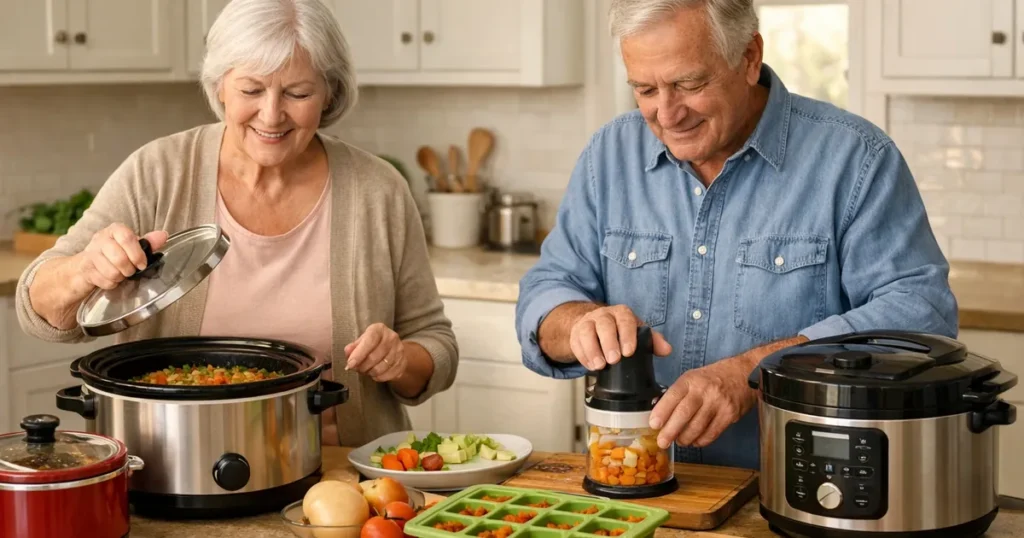
Soup can be a comforting, practical meal when cooking needs to feel manageable rather than demanding. The best routine is often not a complicated recipe; it is a dependable way to chop a few ingredients, let them cook gently, and save a serving for another day. For older adults, details such as a clear control, a stable appliance, a lighter pot, and a simple cleanup process can make a meaningful difference.
These simple soups seniors can make at home are easier to approach when the equipment matches the household. A manual slow cooker can limit stovetop monitoring, while a compact chopper can reduce repetitive knife work. A multicooker may suit someone comfortable reading a display, and a portion tray can make leftovers less wasteful. Family caregivers can help set up a new appliance, label frozen meals, and confirm that frequently used controls are easy to see.
Safety still comes first. Keep appliances on a dry, level counter, use handles or two hands for a full removable pot, and let hot soup cool before dividing it into portions. Choose recipes with familiar ingredients and straightforward steps. If a person has swallowing concerns, diabetes, a sodium restriction, appetite changes, or another dietary need, a clinician or registered dietitian can offer guidance suited to that individual. With a realistic setup, simple soups seniors can make at home can support independence without turning dinner into a tiring project.
Quick Picks
Best Overall: Hamilton Beach 4-Quart Slow Cooker (33140G)
Its four-quart removable stoneware, tactile dial, and low, high, and warm settings offer a straightforward middle ground for regular soup meals.
Best Budget: Elite Gourmet MST-250XS 1.5-Quart Slow Cooker
This compact 1.5-quart manual cooker is positioned for smaller portions, with fewer leftovers to manage and a lighter-sized crock to clean.
Easiest to Use: Crock-Pot 7-Quart Oval Manual Slow Cooker
Three tactile settings keep operation uncomplicated for batch cooking, provided the large removable crock can be handled safely with two hands.
Simple soups seniors can make at home comparison table
| Product | Type | Key features | Why it may help | Amazon |
|---|---|---|---|---|
| Hamilton Beach 4-Quart Slow Cooker (33140G) | Manual slow cooker | Four-quart removable stoneware; Low high and warm settings; Simple control dial; Dishwasher-safe crock and lid | The tactile dial avoids menu navigation, and the moderate crock size is easier to manage than an extra-large insert. | |
| Elite Gourmet MST-250XS 1.5-Quart Slow Cooker | Compact manual slow cooker | 1.5-quart ceramic crock; Low high and warm settings; Compact footprint; Dishwasher-safe crock and lid | The small crock suits one- or two-person portions and requires less lifting and cleaning. | |
| Crock-Pot 7-Quart Oval Manual Slow Cooker | Large manual slow cooker | Seven-quart stoneware; High low and warm settings; Removable crock; Dishwasher-safe stoneware and lid | Three tactile settings are straightforward, although the large crock should be lifted with two hands. | |
| Cuisinart Cook Central 3-in-1 Multicooker | Programmable multicooker | Slow cook brown-saute and steam modes; Backlit display; Programmable timer; Removable nonstick pot | Browning and slow cooking in one pot reduces transfers between hot cookware and the sink. | |
| Instant Pot Duo 7-in-1 Electric Pressure Cooker (6 Quart) | Digital multicooker | Seven cooking functions; Six-quart stainless pot; One-touch programs; Keep-warm mode; Safety protections | One appliance replaces several pots and offers repeatable programs once a caregiver helps with setup. | |
| Souper Cubes 1-Cup Silicone Freezer Tray with Lid | Portioning freezer tray | One-cup portion marks; Flexible silicone wells; Reinforced rim; Fitted lid; Freezer and oven safe | Premeasured wells make it easy to freeze soups and one-pot meals in single-meal portions. | |
| Cuisinart Mini-Prep Plus 3-Cup Food Processor | Compact food chopper | Three-cup work bowl; Chop and grind controls; Reversible stainless-steel blade; Dishwasher-safe bowl and lid | Powered chopping reduces repetitive knife work for small batches and everyday meal preparation. |
Detailed Reviews
Hamilton Beach 4-Quart Slow Cooker (33140G)
The Hamilton Beach 4-Quart Slow Cooker (33140G) is a manual slow cooker built around a four-quart removable stoneware crock. Its dial has low, high, and warm settings, avoiding menu screens and multi-step programming. That direct approach can be useful when vision, memory, or comfort with technology makes a familiar physical control preferable. Four quarts leaves room for a family-sized pot of vegetable, bean, chicken, or lentil soup without moving into an especially large format.
For an older adult cooking independently, the moderate crock size is an important practical advantage. It can still make several servings, yet it may be easier to manage than an extra-large insert when washing or transferring cooled leftovers. The dishwasher-safe crock and lid simplify the end of the meal. As with any removable stoneware, it is wise to plan where the hot crock will rest before lifting it and to use both hands when it contains soup.
Pros
- Four-quart removable stoneware
- Tactile control dial
- Low, high, and warm settings
- Dishwasher-safe crock and lid
Cons
- Manual settings do not provide a programmable timer
- A filled crock still requires careful two-handed handling
Best for…
- Regular soup batches
- Cooks who prefer a dial
- Households wanting dishwasher-safe parts
Elite Gourmet MST-250XS 1.5-Quart Slow Cooker
The Elite Gourmet MST-250XS 1.5-Quart Slow Cooker is a compact manual option with a 1.5-quart ceramic crock. Low, high, and warm settings cover the basic rhythm of slow-cooked soup, while the small footprint may be easier to fit on an uncluttered counter. It is especially relevant when one person, or two people with modest appetites, does not need a large pot of leftovers after every meal.
Its smaller ceramic crock can mean less lifting, less food to portion, and less surface area to wash. The crock and lid are dishwasher-safe, which may help a caregiver or older cook keep cleanup predictable. The tradeoff is capacity: this is not the choice for a large family gathering or a week of freezer meals from one batch. It works best when ingredients are measured for a small recipe and the counter has a stable, dry place for the appliance.
Pros
- Small 1.5-quart ceramic crock
- Compact footprint
- Low, high, and warm settings
- Dishwasher-safe crock and lid
Cons
- Limited capacity for batch cooking
- Manual controls do not include programming
Best for…
- One-person portions
- Two smaller servings
- Small kitchen counters
Crock-Pot 7-Quart Oval Manual Slow Cooker
The Crock-Pot 7-Quart Oval Manual Slow Cooker uses a seven-quart stoneware insert and three tactile settings: high, low, and warm. Its uncomplicated control arrangement can be easier to understand than a panel of buttons. For soups that are meant to feed visiting family, support meal sharing, or create multiple servings for later, the larger capacity provides room to cook a substantial batch in one appliance.
The same capacity that helps with batch cooking also deserves careful consideration. A seven-quart crock can become heavy when full, so it should be lifted with two hands and only when there is a clear place to set it down. The removable crock, dishwasher-safe stoneware, and dishwasher-safe lid assist with cleanup, but a smaller cooker may be more practical for everyday solo meals. This model fits cooks who value simple settings and have safe help or confidence handling a larger vessel.
Pros
- Seven-quart stoneware capacity
- Three tactile settings
- Removable crock
- Dishwasher-safe stoneware and lid
Cons
- Large crock should be lifted with two hands
- May make more food than a small household needs
Best for…
- Large soup batches
- Sharing meals with family
- Cooks who want simple settings
Cuisinart Cook Central 3-in-1 Multicooker
The Cuisinart Cook Central 3-in-1 Multicooker combines slow cook, brown-sauté, and steam modes in one appliance. A backlit display and programmable timer offer more guidance than a basic dial, while the removable nonstick pot supports the cooking process from start to finish. For soup making, the ability to brown or sauté ingredients and then slow cook in the same pot can reduce transfers between hot cookware and the sink.
This is a more involved choice than a manual slow cooker, so it is best for someone who can comfortably read the display and follow programmed controls, or who has a caregiver help with initial setup. The timer can support a planned meal schedule, but it also asks the cook to select settings deliberately. The removable nonstick pot is a helpful cleanup feature. Keep the controls visible, review the instructions before first use, and avoid trying to learn every mode at once.
Pros
- Slow cook, brown-sauté, and steam modes
- Backlit display
- Programmable timer
- Removable nonstick pot
Cons
- More controls than a manual cooker
- Display-based operation may take practice
Best for…
- One-pot soup preparation
- Cooks who want browning capability
- People comfortable with programmed controls
Instant Pot Duo 7-in-1 Electric Pressure Cooker (6 Quart)
The Instant Pot Duo 7-in-1 Electric Pressure Cooker (6 Quart) is a digital multicooker with seven cooking functions, a six-quart stainless pot, one-touch programs, keep-warm mode, and safety protections. Its broad function set can replace several separate pots or appliances in a kitchen. Once the controls and routine are familiar, repeatable programs may help make soup preparation feel more consistent from one meal to the next.
Because this model uses digital controls and multiple functions, it is not necessarily the simplest first appliance for every older cook. A caregiver can be useful during setup and while establishing a small set of preferred programs. The stainless pot provides a removable cooking vessel, but six quarts of soup can still be substantial to move. Read the manufacturer instructions carefully, follow the appliance’s safety directions, and choose a clear counter location where the display and controls can be seen comfortably.
Pros
- Seven cooking functions
- Six-quart stainless pot
- One-touch programs
- Keep-warm mode
- Safety protections
Cons
- Digital interface has a learning curve
- A full six-quart pot can be heavy
Best for…
- Cooks seeking several functions in one appliance
- Repeatable programmed cooking
- Caregiver-assisted setup
Souper Cubes 1-Cup Silicone Freezer Tray with Lid
The Souper Cubes 1-Cup Silicone Freezer Tray with Lid is not a cooker, but it can make a soup routine far easier to sustain. Its one-cup portion marks provide a clear way to divide cooled soup into individual servings instead of freezing one large container. Flexible silicone wells, a reinforced rim, and a fitted lid are designed for portioning and storing meals with less guesswork about how much is in each serving.
This tray is useful after a slow cooker or multicooker has done the main cooking. Let soup cool appropriately before portioning, keep the tray on a stable surface while filling it, and use the fitted lid for freezer storage. The reinforced rim may help when moving the tray, though it should still be carried level. Its freezer- and oven-safe design adds flexibility, but the main senior-friendly advantage is simple meal organization: one prepared batch can become several clearly measured servings.
Pros
- One-cup portion marks
- Flexible silicone wells
- Reinforced rim
- Fitted lid
- Freezer- and oven-safe
Cons
- Does not cook soup
- Filled tray should be carried level
Best for…
- Freezing individual portions
- Reducing oversized leftovers
- Organizing prepared meals
Cuisinart Mini-Prep Plus 3-Cup Food Processor
The Cuisinart Mini-Prep Plus 3-Cup Food Processor is a compact food chopper with a three-cup work bowl, chop and grind controls, and a reversible stainless-steel blade. For soup preparation, powered chopping can reduce repetitive knife work when handling small quantities of vegetables, herbs, or other ingredients. The compact bowl also encourages manageable prep amounts rather than loading a large appliance for a modest recipe.
The bowl and lid are dishwasher-safe, which can make cleanup less demanding after ingredient prep. As with any bladed appliance, the blade should be handled deliberately and stored safely when not in use. Its three-cup size is best suited to smaller prep tasks, not a large amount of chopping for a seven-quart batch. This tool pairs naturally with smaller slow-cooker recipes and can support a more comfortable pace in an elderly kitchen when knife work is tiring.
Pros
- Three-cup work bowl
- Chop and grind controls
- Reversible stainless-steel blade
- Dishwasher-safe bowl and lid
Cons
- Small bowl limits large-batch prep
- Blade requires careful handling
Best for…
- Small vegetable-prep tasks
- Reducing repetitive knife work
- Compact kitchens
Buying Guide
Match capacity to the meal routine
Choose capacity based on how many servings will actually be useful. A smaller cooker can reduce lifting, cleanup, and leftover management for one or two people. A larger cooker can make sense for shared meals or planned freezer portions, but a full removable crock is heavier and needs a clear, stable landing spot.
Think about what happens after cooking. If leftovers are welcome, a tray with clearly marked individual wells can turn one pot of soup into organized meals. If leftovers are usually forgotten, a smaller recipe and smaller appliance may be the more supportive choice.
- Small batches can reduce lifting.
- Large batches need safe portioning plans.
- Leave counter space around the appliance.
For another senior-friendly comparison, see our guide to pros and cons of digital displays in senior kitchens before narrowing down your options.
Prioritize controls that are easy to understand
A simple dial can be reassuring because the available choices are visible at a glance. Low, high, and warm settings are often enough for basic soup routines. Digital displays and programmed functions can offer flexibility, but they require clear visibility, comfort with buttons, and a willingness to learn a few steps.
There is no universally best control type. Choose the one the cook can use confidently without rushing. For a closer look at interface tradeoffs, see Pros and Cons of Digital Displays in Senior Kitchens. If a digital appliance is selected, a family member can help write down a short, appliance-specific routine for the most frequently used setting.
- Check whether labels are easy to read.
- Avoid crowded or confusing control panels.
- Keep instructions nearby for new appliances.
You may also find our practical advice about senior kitchen safety checklist (printable – ) helpful while planning an easier-to-use kitchen.
Plan for stability, heat, and lifting
Set a slow cooker or multicooker on a dry, level counter away from the edge. Keep the cord positioned so it is not a trip or snag hazard. Before cooking, decide where a hot lid, spoon, and removable pot will go. This small bit of planning reduces the need to carry hot items across the kitchen.
A removable crock or pot is convenient, but it becomes much heavier with soup inside. Use two hands, avoid overfilling, and ask for help when lifting feels uncertain. Do not treat an automatic or keep-warm feature as a substitute for following the manufacturer’s directions. The Senior Kitchen Safety Checklist (Printable – 2026) is a useful companion for reviewing the wider kitchen setup.
- Use a stable, uncluttered counter.
- Keep handles and cords easy to reach.
- Let hot soup cool before freezing portions.
Make cleanup and noise part of the decision
An appliance is more likely to be used when cleanup is not exhausting. Dishwasher-safe lids, crocks, bowls, and pots can reduce hand washing, although they still need safe handling when wet. A removable pot can also make it easier to serve soup at the counter rather than trying to ladle from a fixed appliance.
Noise matters in a quiet home, especially when a person is sensitive to sudden sounds or shares a living space. Consider where the appliance will sit and whether the cook finds beeps or operational sounds distracting. The best choice is one that fits the household’s comfort level and leaves the cook feeling in control.
- Choose parts that fit the cleanup routine.
- Dry hands before touching controls.
- Keep frequently used tools within easy reach.
Frequently Asked Questions
What is the easiest appliance for simple soup meals?
For many people, a manual slow cooker is the easiest starting point because the controls may be limited to low, high, and warm. A tactile dial can be simpler than navigating a display. The right choice still depends on the cook’s comfort, the desired batch size, and whether lifting a removable crock is manageable.
Is a small slow cooker enough for one older adult?
A compact cooker can be a sensible fit for one person or two smaller servings. It can reduce the amount of food to portion and the weight of the crock during cleanup. Consider the recipe size carefully, since a small cooker is not intended for the same volume as a large family batch.
How can soup be frozen in manageable portions?
Cool the soup appropriately, then divide it into clearly measured individual portions. A tray with one-cup marks can help make servings easier to identify later. Keep the tray level while filling and moving it, use its lid for storage, and label portions according to the household’s normal food-storage routine.
Are digital multicookers suitable for seniors?
They can be suitable for someone who reads the display comfortably and is willing to learn a few regular programs. They may also work well when an adult child or caregiver helps with setup. A manual cooker is often the better match when fewer choices and a physical dial inspire more confidence.
How can an older cook reduce knife work for soup?
A compact food chopper can handle small prep tasks and reduce repetitive chopping. Use it only as directed, handle its blade carefully, and keep the bowl from sliding on the counter. It is also reasonable to choose recipes with fewer chopped ingredients or ask family to prepare ingredients in advance.
What safety steps matter most when making soup?
Use a stable, dry counter; keep cords out of the way; and decide where hot cookware will be placed before cooking begins. Lift full removable pots with two hands, or ask for help. Allow hot soup to cool before dividing it into freezer portions, and always follow the appliance manufacturer’s directions.
Conclusion
A dependable soup routine does not require the most complicated appliance. A four-quart manual cooker offers a balanced everyday option, while a compact cooker can better suit smaller meals and a large cooker can support batch cooking. Multicookers add functions for people comfortable with displays, while a chopper and portion tray can make preparation and leftovers easier to manage.
Start with the part of cooking that feels hardest: chopping, monitoring a pot, handling leftovers, or cleaning up. Then choose a tool that reduces that particular task. A calm setup, familiar recipes, and sensible safety habits can help soup remain a practical meal at home.