
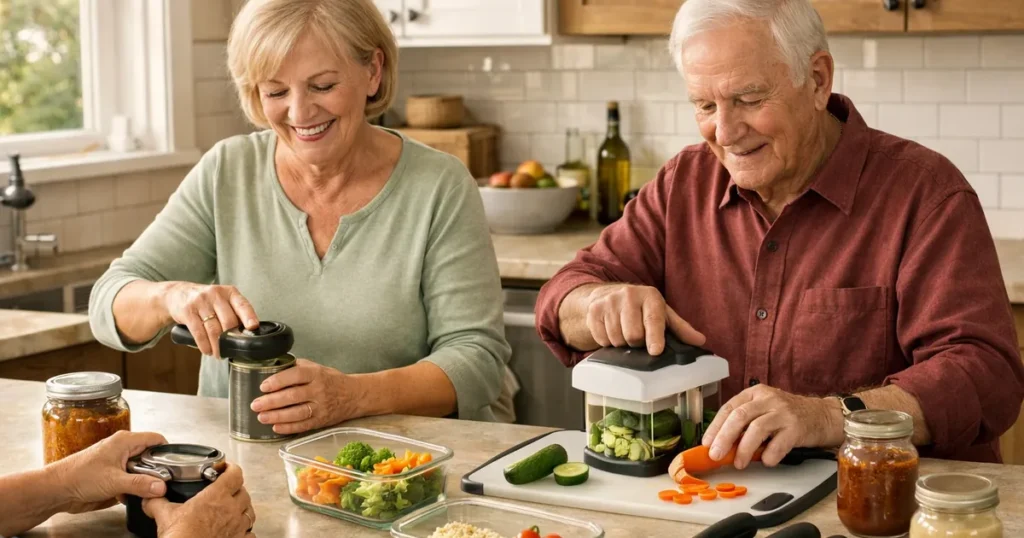
Meal preparation can make weekday eating simpler, but stiff fingers, sore wrists, and reduced grip can turn ordinary tasks into tiring work. Opening a jar, holding a slippery vegetable, or repeatedly chopping ingredients may limit independence more than the recipe itself. Learning how to meal prep with arthritis pain starts with changing the workload rather than pushing through discomfort. The aim is not to prepare everything at once. It is to make a few useful foods with less strain and fewer risky movements.
A senior-friendly setup favors steady surfaces, larger grips, fewer repeated motions, and short work periods with rests between them. It can also help an adult child support a parent without taking over every task. Choose familiar ingredients, prepare only a few components at a time, and use tools that reduce twisting, force, and close knife work. If pain is new, severe, or interferes with daily activities, discuss kitchen adaptations with an appropriate clinician or occupational therapist. Consult a clinician or registered dietitian when food choices involve a medical diet.
Quick Picks
Best Overall: Hamilton Beach Smooth Touch Electric Automatic Can Opener (76606AG)
The one-hand lever, side-cutting action, and extra-tall stable base address a common meal-prep obstacle: opening canned ingredients with less gripping and less contact with sharp rims. It is a practical choice for cooks who regularly use canned beans, vegetables, fruit, or broth.
Best Budget: OXO Good Grips Jar Opener with Base Pad
This compact manual option combines a non-slip base pad with V-shaped teeth to help steady many jar sizes and reduce the wrist force needed for stubborn lids. It is a simple fit for households needing occasional help with sauces, condiments, and other jarred meal-prep staples.
Easiest to Use: Fullstar Vegetable Chopper and Spiralizer
Its contained push-down design, collection container, and non-slip base can streamline vegetable prep while reducing repetitive knife work and scattered ingredients. It can be useful when several vegetables are needed for soups, salads, casseroles, or freezer-ready mixes.
How to meal prep with arthritis pain comparison table
| Product | Type | Key features | Why it may help | Amazon |
|---|---|---|---|---|
| Hamilton Beach Smooth Touch Electric Automatic Can Opener (76606AG) | Smooth-edge electric can opener | One-hand push-down lever; Cuts along the side of the can; Works with standard and pop-top cans; Extra-tall stable base | The large lever requires little hand strength, and the smooth-edge cut reduces contact with sharp metal rims. | |
| OXO Good Grips Jar Opener with Base Pad | Manual jar opener | Non-slip base pad; V-shaped stainless-steel teeth; Fits many lid sizes; Compact storage | The base steadies the jar while the toothed opener reduces wrist force and slipping. | |
| Fullstar Vegetable Chopper and Spiralizer | Countertop vegetable chopper | Interchangeable cutting inserts; Collection container; Non-slip base; Reduces repetitive knife work | A contained push-down chopper can reduce prolonged knife handling and repetitive wrist motion. | |
| Epicurean All-in-One Non-Slip Cutting Board | Non-slip cutting board | Non-slip corners; Juice groove; Knife-friendly surface; Dishwasher-safe construction | A board that stays put reduces unexpected movement during cutting and simplifies cleanup. | |
| BUNMO Weighted Utensils 3-Piece Set | Weighted adaptive utensil set | Weighted stainless-steel pieces; Wide handles; Three-piece set; Designed for tremor support | Added weight and broad handles may improve control for users with tremors or weak grip. | |
| OXO Good Grips Twisting Jar Opener with Base Pad | Low-effort manual jar opener | Twisting handle; Oversized nonslip grip; Non-slip base pad; Fits a range of lid sizes | The broad handle and stabilizing pad reduce grip force and help keep the jar from sliding. | |
| OXO Good Grips Swivel Vegetable Peeler | Large-handle vegetable peeler | Oversized nonslip handle; Twin swivel blades; Built-in potato eyer; Rust-resistant blade; Dishwasher safe | The wide cushioned handle is easier to control with limited grip strength than a narrow metal peeler. |
Detailed Reviews
Hamilton Beach Smooth Touch Electric Automatic Can Opener (76606AG)
The Hamilton Beach Smooth Touch Electric Automatic Can Opener is a smooth-edge electric can opener for standard and pop-top cans. Its push-down lever supports one-hand operation, which can help when one hand is sore or needs to steady the counter. The extra-tall base provides a stable place for opening canned beans, tomatoes, broth, or fruit during a prep session. Keeping this task on the counter can avoid the repeated gripping and twisting required by manual openers.
Instead of cutting through the top rim, this opener cuts along the side of the can. That smooth-edge approach can reduce contact with sharp metal rims when setting aside lids or transferring food. It is a focused tool rather than a general prep station, so it suits households that regularly use canned ingredients. Clear the surrounding counter before use so cans, lids, and prepared ingredients have separate places.
Pros
- One-hand push-down lever
- Cuts along the can side
- Works with standard and pop-top cans
- Extra-tall stable base
- May reduce contact with sharp rims
Cons
- Designed specifically for cans
- Requires counter space during use
Best for…
- Frequent canned ingredients
- Limited hand strength
- Safer lid handling
OXO Good Grips Jar Opener with Base Pad
The OXO Good Grips Jar Opener with Base Pad is a manual opener built around two useful jobs: holding the jar steady and gaining traction on the lid. The non-slip base pad helps reduce sliding on the counter, while V-shaped stainless-steel teeth grip many lid sizes. For meal prep, it can make sauces, salsa, pickles, and other jarred staples easier to open before cooking begins, without tightly clamping the jar in one hand.
This compact tool is useful in a small elderly kitchen or for anyone who does not want another countertop appliance. It still involves a manual turning motion, so it may not suit every level of arthritis pain. However, the base pad can reduce the need to hold the jar tightly, making the task more controlled than opening a lid on an unprotected counter. Use it on a dry, stable surface and avoid forcing a lid that will not move.
Pros
- Non-slip base pad
- V-shaped stainless-steel teeth
- Fits many lid sizes
- Compact storage
Cons
- Still requires manual twisting
- Only assists with jar lids
Best for…
- Jarred sauces and condiments
- Small kitchens
- Reducing jar movement
Fullstar Vegetable Chopper and Spiralizer
The Fullstar Vegetable Chopper and Spiralizer is a countertop vegetable chopper with interchangeable cutting inserts and a collection container. It shifts much of the work from repeated slicing to a contained push-down action. That can help when preparing vegetables for several meals, especially for cooks who find prolonged knife handling tiring on the hands and wrists. The container also gives prepared food one place to stay while the next ingredient is handled.
Its non-slip base helps keep the unit steadier while ingredients are processed, and the collection container keeps cut food together instead of spreading it across the board. The inserts add flexibility, but they also mean there are separate parts to handle and clean. Use deliberate movements and choose ingredients that fit the tool comfortably. Plan cleanup before beginning so cutting inserts are not left loose in the sink.
Pros
- Interchangeable cutting inserts
- Collection container
- Non-slip base
- Reduces repetitive knife work
- Contained prep area
Cons
- Multiple pieces require cleaning
- Cutting inserts need careful handling
Best for…
- Batch vegetable prep
- Reducing knife repetition
- Keeping chopped food contained
Epicurean All-in-One Non-Slip Cutting Board
The Epicurean All-in-One Non-Slip Cutting Board addresses the surface beneath the food, an often-overlooked part of safer prep. Its non-slip corners are intended to limit unexpected board movement, while the juice groove can help contain liquids from produce or cooked foods. A board that remains in place can make cutting feel more predictable when grip strength or hand control is limited. It also creates a defined prep area instead of asking the cook to manage food on a moving surface.
The knife-friendly surface supports regular chopping tasks, and dishwasher-safe construction may simplify cleanup after a short prep session. It does not eliminate the need for safe knife habits or reduce the force needed to cut firm foods. Pair it with smaller batches, stable food placement, and pre-cut ingredients when needed. Wipe away moisture promptly so the board and counter remain as stable as possible.
Pros
- Non-slip corners
- Juice groove contains liquids
- Knife-friendly surface
- Dishwasher-safe construction
Cons
- Does not reduce cutting force
- Still requires safe knife technique
Best for…
- A steadier cutting surface
- Messy produce prep
- Simpler cleanup
BUNMO Weighted Utensils 3-Piece Set
The BUNMO Weighted Utensils 3-Piece Set includes weighted stainless-steel pieces with wide handles. Although utensils are usually associated with eating rather than prep, they can support small kitchen tasks such as stirring, mixing, and portioning foods after cooking. The broader handles may be easier to hold than narrow utensil handles for people with weak grip or reduced hand control. They may help keep familiar, lower-effort steps within the older cook's routine.
The added weight is designed for tremor support and may improve control for some users. Because comfort and control vary, begin with simple, low-risk tasks such as stirring a cool mixture or serving a soft food. This three-piece set is a supportive option for familiar utensil work, not a substitute for adapting heavier pans, hot liquids, or demanding cooking steps. If the added weight feels tiring, choose a lighter task or pause.
Pros
- Weighted stainless-steel pieces
- Wide handles
- Three-piece set
- Designed for tremor support
Cons
- Not a cutting tool
- Added weight may not suit every user
Best for…
- Stirring and serving tasks
- Wide-handle preference
- Tremor-support needs
OXO Good Grips Twisting Jar Opener with Base Pad
The OXO Good Grips Twisting Jar Opener with Base Pad is a manual option for lids, using a twisting handle with an oversized nonslip grip. The included base pad helps hold the jar in place while the opener handles the lid. This separation can reduce the need to squeeze the jar tightly and twist with both hands at once, a movement that can aggravate sore fingers or wrists. Its handle-based design may suit cooks who prefer a broad place to grip.
It fits a range of lid sizes, making it practical for meal-prep staples such as pasta sauce, nut butter, or preserved vegetables. It remains a manual tool, so very painful hands may still need assistance or a different approach. For those who can manage a controlled twisting motion, the broader grip and stabilizing pad can make opening jars feel less precarious. Keep the jar dry, work slowly, and stop rather than applying excessive force.
Pros
- Oversized nonslip grip
- Twisting handle
- Non-slip base pad
- Fits a range of lid sizes
Cons
- Requires manual turning
- Not intended for cans
Best for…
- Users who prefer a handle
- Reducing jar slippage
- Several common lid sizes
OXO Good Grips Swivel Vegetable Peeler
The OXO Good Grips Swivel Vegetable Peeler has an oversized nonslip handle intended to be easier to control than a narrow metal handle. Its twin swivel blades follow the shape of vegetables, while the built-in potato eyer handles small blemishes without switching tools. For meal prep, a more secure handle can make peeling potatoes, carrots, apples, or similar produce less taxing on the grip. It can be useful when peeling is limited to one or two ingredients rather than a large batch.
The rust-resistant blade and dishwasher-safe design support routine use and cleanup. Peeling still involves repetitive movement, so break the job into small batches rather than working through a large pile at once. Keep produce stable on the counter or board, peel away from the body, and stop if control fades. Choosing unpeeled produce or frozen alternatives can also reduce the total peeling required.
Pros
- Oversized nonslip handle
- Twin swivel blades
- Built-in potato eyer
- Rust-resistant blade
- Dishwasher safe
Cons
- Peeling remains repetitive
- Requires controlled hand movement
Best for…
- Limited grip strength
- Routine vegetable peeling
- Easy-clean kitchen tools
Buying Guide
Build meal prep around fewer hard motions
The most useful change is often reducing how often painful motions occur. Plan two or three flexible meal components instead of cooking many separate recipes. A cooked protein, prepared vegetables, and a grain or starch can be combined in different ways. Buy pre-washed greens, canned beans, frozen vegetables, or pre-cut produce when they help conserve hand energy. Doing less from scratch is a sensible adaptation. Choose recipes that can be paused and finished later rather than recipes requiring many steps at one time.
Work in short sessions. Set out containers, ingredients, and tools first, then complete one task before moving on. A chair or stool at a safe counter height may make standing easier, while a clear counter reduces reaching and searching. Top 7 Kitchen Shortcuts for Elderly Cooks is a useful companion when the goal is to remove unnecessary steps. A written list can help a caregiver shop for ingredients that are washed, chopped, or easy to open.
- Choose recipes with overlapping ingredients.
- Prep one category at a time.
- Schedule rest before pain builds.
- Use smaller containers that are easier to handle.
- Save demanding tasks for a more comfortable time of day.
For another senior-friendly comparison, see our guide to kitchen shortcuts for elderly cooks before narrowing down your options.
Make the workspace stable and easy to see
A stable board, a dry counter, and good lighting can matter as much as the cutting tool. Put frequently used items within easy reach and avoid carrying heavy cookware across the kitchen. Use a damp cloth under a board only if it does not interfere with the board's own non-slip features. Keep handles turned inward and create a dedicated place for hot items away from the main prep area. Before starting, remove mail, dishes, and packaging that crowd the work surface.
Vision changes can make small edges, wet spots, and clutter harder to notice. Bright, even light and a cleared path to the sink can help. Review the Senior-Friendly Kitchen Safety Checklist: 30 Checks for Aging Parents alongside a new routine, particularly when a family member is helping set up a safer kitchen. If a task repeatedly feels unstable, change the task, the tool, or the meal plan instead of forcing it.
- Dry spills promptly.
- Keep knives separate from loose utensils.
- Use high-contrast bowls when helpful.
- Avoid rushed prep near the stove.
- Keep a clear route between counter, sink, and refrigerator.
You may also find our practical advice about senior-friendly kitchen safety checklist: 30 checks for aging parents helpful while planning an easier-to-use kitchen.
Choose tools by the limiting task
Match the tool to the motion that causes trouble. A jar opener helps with twisting, an electric can opener helps with gripping and lid edges, and a chopper can reduce repeated knife work. Do not assume one adaptive item solves every issue. Consider whether the person can safely lift it, hold it steady, clean it, and store it where it can be reached without strain. Controls and grips should be understandable without fine finger movements or complicated setup.
Cleaning deserves attention before buying. Tools with several pieces may save effort during prep but add steps afterward. Decide whether those steps are manageable on the same day, and avoid leaving cutting components in a sink where they are hard to see. Batch Cooking Tips for Grandparents offers ideas for dividing cooking into manageable stages. When planning how to meal prep with arthritis pain, the best tool usually removes a specific difficult motion while fitting the cook's habits and storage.
- Favor clear, comfortable controls.
- Check whether parts feel manageable.
- Store daily tools at waist height.
- Ask for help with painful or risky tasks.
- Choose tools that suit often-prepared meals.
For related buying considerations, explore our guide to batch cooking tips for grandparents as part of your comparison.
Frequently Asked Questions
What is the easiest way to start meal prepping with arthritis pain?
Start with one meal component rather than a full week of meals. Prepare a vegetable, a protein, or a soup base that can be used over two or three days. Set out ingredients before beginning, use a stable cutting surface, and stop between tasks. A smaller plan is easier to repeat and helps identify which motions need an adaptation. Once that component feels manageable, add another simple item rather than increasing every task at once.
Should seniors avoid using knives when their hands hurt?
Not necessarily, but the task should match the person's comfort and control. Use a stable board, good lighting, and smaller amounts of food. Pre-cut, frozen, or soft ingredients can reduce knife work. If holding a knife feels unsteady, painful, or unsafe, choose another preparation method or ask for assistance rather than continuing through discomfort. Keep knives clean and separate from other utensils so they are easy to identify and put away.
Can jar openers help with arthritis?
A jar opener with a stabilizing base can reduce slipping and the grip force needed to hold a jar. Manual models still require some turning, so they may not suit everyone. Place the jar on a stable, dry surface and use slow, controlled pressure. Do not use excessive force if the lid does not release. It may help to ask another person to handle especially tight lids before meal prep begins.
How can caregivers help without taking away independence?
Caregivers can set up the workspace, open difficult packaging, wash produce, or handle tasks involving heavy pans and sharp cutting. Let the older adult choose meals and complete comfortable steps such as mixing, portioning, or labeling containers. Asking which task is most difficult is usually more helpful than assuming every kitchen job must be done for them. Agreeing on a simple stop point can make it easier to pause before fatigue becomes a safety concern.
What foods are good for low-effort meal prep?
Choose ingredients that need little trimming, peeling, or chopping: canned beans, frozen vegetables, pre-washed salad greens, yogurt, cooked grains, rotisserie chicken, and soft fruits are examples. The best choices depend on dietary needs and preferences. Anyone following a medical diet, including sodium or carbohydrate limits, should check with a clinician or registered dietitian for individualized guidance. Select foods that can be portioned with familiar utensils and stored in containers that are comfortable to lift.
How often should prepared food be handled during the week?
Keep handling simple and organized. Portion food into manageable containers when it is prepared, label it clearly, and avoid repeatedly moving the same heavy dish in and out of the refrigerator. Plan meals so the easiest items are most accessible. If lifting containers causes pain or feels unsafe, divide food into smaller portions or get assistance. Limiting unnecessary transfers between bowls, pans, and storage containers can reduce both effort and clutter.
Conclusion
Meal prep with arthritis pain works best when the kitchen asks less of sore hands. Stable surfaces, larger grips, tools for tough twisting tasks, and shorter prep sessions can make familiar meals more manageable. The right choice depends on the step that causes the most trouble: opening cans, loosening jars, chopping produce, peeling, or keeping the work area steady.
Begin with one or two changes and keep the routine comfortable. A practical setup should support independence while leaving room to pause, simplify, use prepared ingredients, or ask for help when a task does not feel safe. Consistent, smaller prep sessions are often more useful than an exhausting full-day project.