
5 Best Slow Cookers for Elderly Cooks (2026 Guide)
Disclosure: This post contains affiliate links. If you click and buy, we may receive a small commission at no extra cost to you. As an Amazon Associate, we earn from qualifying purchases.
⭐ Why Slow Cookers are a Game-Changer for Seniors
As our parents age, everyday tasks like cooking can become more physically demanding or even hazardous. That’s why investing in a safe, easy-to-use slow cooker can make a huge difference in their daily lives. Whether your elderly loved one enjoys preparing comforting soups or slow-cooked stews, a slow cooker simplifies everything — just add ingredients, turn the dial, and wait for the aroma to fill the kitchen.
In this guide, we’ve carefully reviewed and compared the 5 best slow cookers for elderly cooks in 2026. These options were selected for their safety, simplicity, and senior-friendly designs.
📎 Comparison Table: 5 Best Slow Cookers for Seniors
| Product | Type | Key Features | Why Seniors Love It | Amazon |
|---|---|---|---|---|
| Crock-Pot 7-Quart Manual | Manual | Large capacity, simple dial | Big dial, no digital confusion | 🛒 Check Price on Amazon |
| Hamilton Beach 6-Quart Portable | Manual + Lock Lid | Lid latch, dishwasher-safe insert | Safer and great for transporting | 🛒 Check Price on Amazon |
| Elite Gourmet MST-250XW | Mini (1.5 Qt) | Compact, low-watt | Perfect for one person, lightweight | 🛒 Check Price on Amazon |
| Cuisinart 3-in-1 Cook Central | Digital Multi-Cooker | Slow cook, sauté, steam | Great for variety, easy interface | 🛒 Check Price on Amazon |
| BLACK+DECKER SCD7007SSD | Digital + Probe | Temp probe, auto keep-warm | High-tech and user-friendly | 🛒 Check Price on Amazon |
🔍 Detailed Reviews of the Best Slow Cookers for Seniors
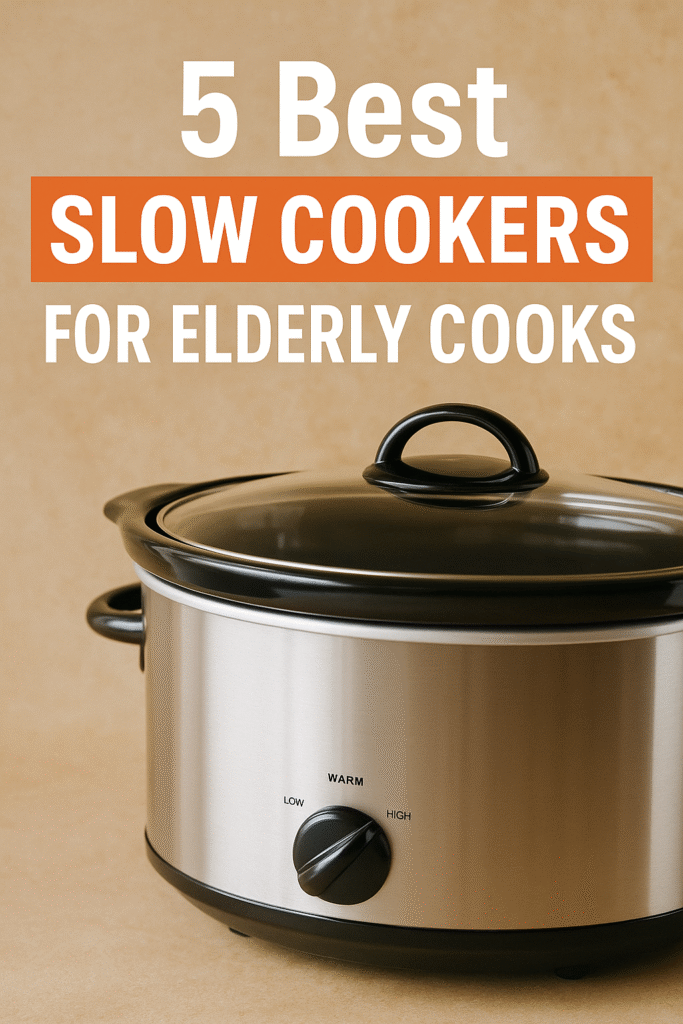
Crock-Pot 7-Quart Manual Slow Cooker
This cooker appears in the comparison table but previously had no matching individual review. Its manual-style controls may appeal to someone who prefers a straightforward routine, while its larger capacity may suit shared meals better than cooking for one. Check the exact model’s control labels and the weight of its removable insert before choosing it for a person with limited grip. A large pot can be difficult to carry to the sink even when the controls are simple.
For daily use, plan where the cooker will stand, where its cord will run and where the hot insert can rest after cooking. Compare the actual amount of food the household makes with the usable capacity in the manufacturer instructions. Follow the manual for lid and cleaning steps, and follow food-safety guidance for thawing ingredients, checking doneness and promptly refrigerating leftovers. The existing product link remains in the comparison table.
Hamilton Beach 6-Quart Portable Slow Cooker (Model 33967A)

This slow cooker is a favorite for seniors who want safety, portability, and no-fuss cooking. The clip-tight sealed lid helps prevent spills, making it a perfect choice for potlucks or just worry-free kitchen use. It features a simple manual dial with keep-warm setting.
- Pros: Lid locks for transport, dishwasher-safe insert, keep-warm setting
- Cons: No timer or digital controls
- Great for: Seniors who want safe, spill-free cooking
Elite Gourmet MST-250XW 1.5 Quart Mini Slow Cooker

Ideal for cooking single servings, this compact slow cooker is lightweight, energy-efficient, and simple to use. Its small size and manual control make it a practical gift for older adults living alone or with limited kitchen space.
- Pros: Compact, low power use, easy to clean
- Cons: Not ideal for cooking large portions
- Great for: Seniors who live alone or have limited storage
Cuisinart 3-in-1 Cook Central Multi-Cooker

This digital slow cooker combines three cooking functions — sauté, steam, and slow cook — in one convenient appliance. The large LCD display and easy push buttons are senior-friendly, while the nonstick insert simplifies cleanup.
- Pros: Multifunctional, large display, dishwasher-safe parts
- Cons: Heavier than basic models
- Great for: Seniors who enjoy versatile cooking options
BLACK+DECKER SCD7007SSD 7-Quart Digital Slow Cooker

With a temperature probe, digital controls, and automatic keep-warm feature, this slow cooker offers additional controls but still requires a careful cooking routine. The locking lid adds safety, and the sleek stainless-steel design looks great in any kitchen.
- Pros: Built-in temperature probe, auto keep-warm, easy interface
- Cons: Slightly more complex than manual models
- Great for: Seniors who appreciate tech support with cooking
📚 How to Choose the Best Slow Cooker for Elderly Users
- Ease of Use: Choose manual knobs over digital buttons for simplicity.
- Weight: Lightweight designs are better for weak hands.
- Safety: Cool-touch handles and auto shut-off are must-haves.
- Size: A smaller capacity is ideal for single seniors, while 6–7 qt works for families.
- Cleaning: Dishwasher-safe inserts save energy and time.
❓ FAQ about Slow Cookers for Seniors
Are slow cookers safe for elderly users?
Yes, especially models with cool-touch exteriors and auto shut-off features.
Can seniors with arthritis use slow cookers?
Definitely — many models have large, easy-to-turn knobs and lightweight designs.
Do slow cookers use a lot of electricity?
No, they’re energy-efficient and cost less to operate than stovetops or ovens.
Is it okay to leave a slow cooker on all day?
Yes, it’s designed for that. Still, models with timers and auto shut-off are safer for seniors.
What size is best for a single senior?
1.5 to 3 quarts is usually enough for 1–2 servings.
Choose Capacity and Controls Around a Real Meal
A large cooker may hold a family stew, but its ceramic insert can be heavy to lift into a sink. Before choosing a model, consider who will clean it, how much food the household usually cooks and where the cooker will live. A small manual dial may be easy to understand yet lack the scheduling features a caregiver needs. A locking travel lid is intended for transport as described in the product manual; do not assume the latches should remain closed throughout cooking.
Put the cooker on a stable, heat-resistant surface with its cord out of the walking route. Check that the lid can be raised without reaching over steam and that a safe landing place is available for the hot insert. Do a dry run with the empty pot before making a full batch.
Food Safety Matters More Than a Long Timer
Thaw frozen meat or poultry safely before adding it to a slow cooker, follow the recipe and cooker instructions, and use a food thermometer to check doneness. Refrigerate leftovers promptly in suitable shallow containers rather than leaving a large batch in the warm cooker. These steps follow USDA slow-cooker food-safety guidance. Automatic keep-warm and a finished cooking cycle do not verify that every ingredient reached a safe temperature.
Match Capacity to the Portions Actually Eaten
Capacity is easiest to judge by the number of meals the household wants, not by the number of people living there. A person who enjoys leftovers may be comfortable with a cooker that makes several portions of chili or soup, while someone who dislikes repeat meals may find a smaller vessel more practical. Consider the usual recipe volume, whether a caregiver shares meals, and freezer space before selecting a size. Avoid choosing a large cooker solely for holidays if it will be awkward to use during ordinary weeks.
Slow cookers generally work best when they are neither nearly empty nor packed to the brim, so recipe scale matters. Look at favorite recipes and note whether they can be halved without creating tiny portions or changing cooking results. A smaller cooker can make oatmeal, applesauce, dips, or a modest stew, but it may not accommodate a whole roast or batch-cooking plan. A larger one can reduce cooking frequency, yet it creates more leftovers that need prompt portioning and refrigeration.
Account for the Weight of a Filled Ceramic Insert
The outer heating base may be manageable, but the removable insert is often the part that strains hands, wrists, shoulders, or balance. It becomes substantially heavier once filled with broth, beans, meat, and vegetables. Rather than judging weight from an empty display unit, imagine lifting it from counter height, carrying it to the sink, and tipping it to drain wash water. Deep, wide inserts can also be difficult for a person with limited reach to hold securely.
A practical approach is to plan meals that do not require moving the full insert while hot. Serve with a long-handled ladle while the cooker remains on the counter, then let food cool appropriately before handling components for cleanup. If a caregiver will wash the insert, that may support a larger capacity choice. If the cook handles cleanup alone, a lighter, smaller vessel or recipes with fewer portions may be the better everyday fit. Handles should be easy to grasp without pressing fingers against a hot surface.
Choose Controls That Fit the Household Routine
A manual control can suit someone who prefers a familiar, repeatable pattern: start cooking after breakfast, check the meal later, and turn the unit off after serving. Fewer settings may mean less uncertainty, particularly for a user who finds screens, symbols, or small buttons frustrating. However, a manual cooker asks the cook or caregiver to remember the next step. Think honestly about whether someone is reliably present to monitor the meal schedule rather than assuming simplicity solves every routine problem.
Programmable controls can help when meals must finish around an appointment, medication schedule, or caregiver visit, but only if the display and programming sequence are easy to read and repeat. Before relying on presets, practice setting a short cycle with the appliance unplugged after use. Keep the instruction manual in a labeled kitchen drawer and write down a preferred routine in plain language. A feature is useful only when the cook understands what it does, including what happens after the selected cooking time ends.
Give the Cooker a Deliberate Countertop Home
Select a counter location before bringing the cooker home. The surface should be level, sturdy, dry, and away from the edge, where a handle or sleeve could catch it. Choose an area with open space above and around the appliance so heat and steam do not collect beneath cabinets or against other items. A location close to the serving area can reduce carrying, but it should not block access to drawers, the sink, or frequently used work space.
Treat the power cord as part of the placement decision. It should reach an appropriate outlet without stretching across a walkway, passing near the sink, or dangling where it can be pulled. Avoid arranging the cooker where a person must lean over the cord to stir or serve. If the available outlet makes safe placement difficult, choose another counter or reconsider the appliance rather than creating a complicated extension-cord setup. Check the manufacturer’s instructions for its electrical and clearance requirements.
Plan for Steam, Lids, and Moving Hot Food
A slow-cooker lid may look light, but steam can escape quickly when it is lifted. Arrange a clear place beside the cooker for the lid before cooking begins, ideally a heat-resistant rest that will catch condensation. Lift the lid away from the face and hands, and avoid placing it on a crowded counter where it could slide or drip. Opening the lid repeatedly can also interrupt cooking, so use a recipe’s suggested checks rather than peeking out of habit.
Carrying a full, hot slow cooker from room to room is a poor routine for many older adults. It is usually easier to set up, cook, and serve in one location. If food must be taken elsewhere, wait until the appliance is off and cool enough to handle, then follow the manufacturer’s guidance for transport. A lid designed to reduce spills does not eliminate the need to keep the cooker level. Ask for help with a heavy batch instead of testing grip strength at the end of a long cooking day.
Build Meals Around Safe Ingredient Preparation
Slow cooking starts before the lid goes on. Organize chopping, measuring, and opening packages while the counter is clear, then refrigerate ingredients that are not ready to cook. For meat and poultry, use a safe thawing method before adding them, rather than placing a solidly frozen piece into the cooker and hoping a long cooking time will compensate. Follow the recipe and appliance directions for ingredient order, liquid amount, and cooking setting, since different foods heat at different rates.
A food thermometer is a useful decision tool, not an optional gadget reserved for elaborate meals. Keep one accessible and learn how to read it before depending on it for roasts, poultry, casseroles, or recipes with several dense ingredients. Test the thickest portion without touching bone or the insert, and compare the reading with reliable food-safety guidance for that food. If vision or hand control makes thermometer use difficult, a caregiver can assist with the final temperature check and portioning step.
Treat Holding Time and Leftovers as Separate Decisions
A warm setting can be convenient for serving, but it should not turn into an indefinite storage plan. Decide before cooking who will eat, when the meal will be served, and how remaining portions will be handled. If dinner is delayed, consult the appliance instructions and use sound judgment about how long food has been held. A finished cycle or warm indicator does not replace checking that the recipe cooked properly or that the food remains suitable to serve.
After the meal, divide leftovers into smaller, shallow containers rather than leaving a large amount in the insert to cool slowly. This also avoids lifting a heavy pot and makes future portions easier to identify. Label containers with the meal and date if memory or shared household routines make that helpful. Refrigerate or freeze portions promptly according to food-safety guidance, and reheat only the amount needed for the next meal. When in doubt about how long food has sat out, discard it rather than trying to rescue it.
Make Cleanup Manageable Before the First Meal
Cleaning is more realistic when the process is planned around the user’s strength and kitchen layout. Check whether the insert fits comfortably in the sink, whether it can be supported while washing, and whether the lid has crevices that are difficult to dry. Do not assume every component can go in a dishwasher; verify the care instructions for the particular appliance. Let all parts cool before washing, and avoid stacking heavy ceramic pieces where they may be hard to retrieve.
Storage deserves equal attention. A cooker that must be lifted from a low cabinet, moved around other appliances, or stored with a loose lid may be used less often. A waist-high shelf or stable counter space can reduce bending and reaching. Keep the manual, thermometer, serving ladle, and any compatible containers nearby so meal preparation does not require searching through several cabinets. If storage is limited, favor an appliance whose size serves the household’s regular meals rather than occasional ambitions.
Use a Small-Batch Plan for Cooking for One
Cooking for one does not have to mean eating the same dish for days. Start with a simple plan: one serving for tonight, one portion for lunch, and one portion to freeze, if the recipe produces enough. Soups, lentils, shredded meat, and vegetable-based sauces can be portioned in different ways with rice, toast, salad, or pasta later. This approach makes a slow cooker useful without creating more food than the household can safely chill, store, and enjoy.
Ingredient preparation can be simplified without relying on highly processed convenience foods. Wash and cut vegetables seated at a stable table if standing is tiring, use premeasured pantry staples, and choose recipes with a short ingredient list. Prepare only what can be safely handled and stored. A caregiver might assemble labeled ingredient packs for later cooking, while the older adult handles the familiar control routine. Keep raw-food preparation separate from ready-to-eat items, and clean hands, utensils, and work surfaces between tasks.
Use This Buyer Checklist Before Making a Final Choice
Before deciding, answer a few practical questions in the kitchen where the cooker will be used: Can the intended cook read the controls in normal lighting? Can they remove the lid without leaning over steam? Is there a clear counter space near an outlet? Can they serve from the pot without lifting it? Can they clean and store the insert comfortably? These answers are more useful than a long list of features, because they reflect the person’s actual daily movements and habits.
Also consider who will help when a routine changes. A caregiver may value a written cooking plan, an easy-to-see timer, or extra capacity for shared meals, while an independent cook may prioritize a lighter insert and straightforward controls. Review the manual’s care, operating, and food guidance before the first recipe, and retain it for reference. The best fit is not necessarily the largest or most feature-filled option; it is the one that fits the cook’s portions, workspace, confidence, and support system.
Choose Recipes That Are Easy to Serve Without Strain
Recipe format matters as much as cooking capacity. Dishes that can be ladled, spooned, or lifted in small pieces are often easier to manage than recipes requiring a large roast to be removed, carved, and returned to the pot. Consider whether the finished meal can be served with one steady utensil and whether it will stay together without extra steps at the counter. Boneless stews, soups, beans, and sauces may suit a household that wants straightforward serving, while larger cuts can create an awkward final task even when the cooking itself was simple.
Also consider the texture the household enjoys. Some slow-cooked vegetables become very soft, while pasta, rice, dairy ingredients, and fresh herbs may need attention near the end of a recipe. A recipe that requires several last-minute additions may not fit someone who expects to sit down as soon as the timer ends. Keep a small collection of familiar recipes with clear finishing steps, and reserve more complicated dishes for days when another person is available to help.
Create a Clear Handoff Plan for Shared Cooking
When an older adult, family member, or caregiver shares kitchen tasks, write down who is responsible for each stage rather than relying on assumptions. One person might shop and prepare ingredients, another might start the cooker, and a third might portion the meal after dinner. A note beside the appliance can list the recipe name, start time, selected setting, and planned serving time. This is especially helpful when visits, errands, or fatigue interrupt a usual routine and more than one person may check on the meal.
A handoff plan should also state what not to change. For example, a helper should know whether ingredients have already been added, whether the meal is intended for dinner or later portions, and whether someone has checked the food before serving. Use simple language that everyone in the household can follow. This approach reduces duplicate steps, prevents well-meaning adjustments to an unfamiliar recipe, and makes the slow cooker easier to include in a dependable support routine.
Further reading: USDA: slow cookers and food safety U.S. Fire Administration: cooking safety.
🎯 Final Thoughts: Which Slow Cooker Stands Out?
If we had to pick one, the Crock-Pot 7-Quart Manual stands out for its simplicity and durability. It’s a perfect all-around option for seniors who value straightforward functionality over fancy features.
If you’re thinking about your parents or loved ones, this small gift can bring big comfort and independence back into their kitchen.
🛒 Check Price on Amazon👉 Also read: Best Electric Kettles for Seniors
👉 Also read: Top Coffee Makers with One-Touch Operation