
This article contains affiliate links. As an Amazon Associate I earn from qualifying purchases.
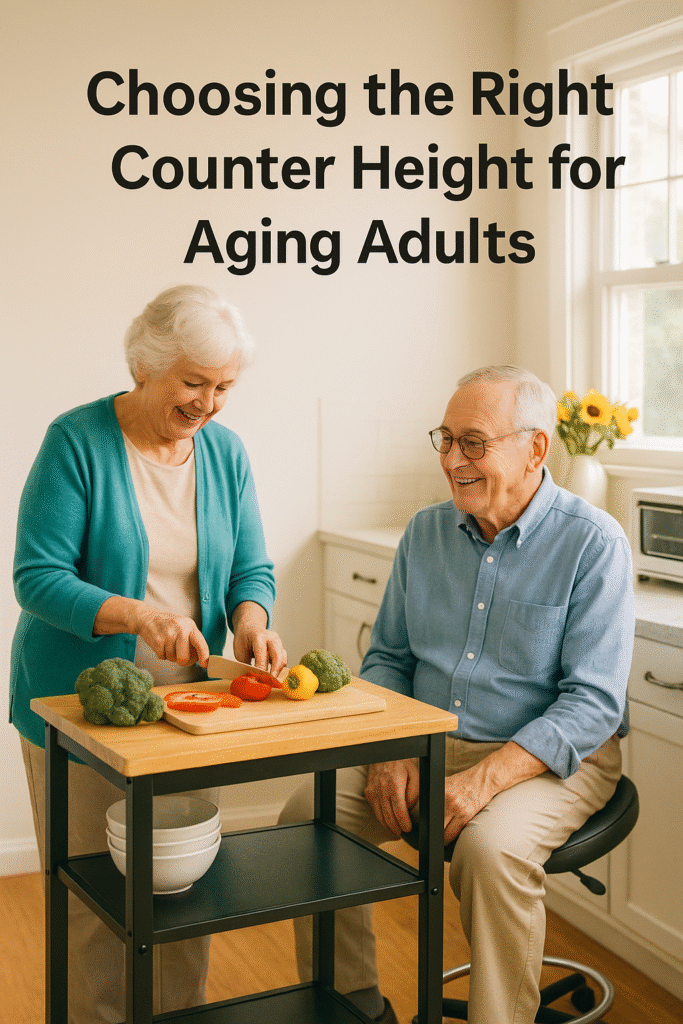
Choosing the right counter height for aging adults starts with the person who will use the kitchen. A standing cook, someone who rests on a supportive stool, and a wheelchair user may need different working arrangements. One carefully planned preparation station can be more useful than changing every cabinet.
This guide helps older adults and family caregivers assess reach, posture, approach space, and the route between preparation, cooking, and cleanup. It provides planning questions rather than a promise that one height will prevent pain or make cooking safe for everyone. Arrange professional assessment before permanent structural, electrical, plumbing, or cooktop changes.
How to Measure a Comfortable Counter Height
An existing kitchen counter may feel comfortable for one cook and awkward for another. Its installed height is not a rule for every body. The most useful height depends on the cook’s elbow height, whether the task is light or forceful, and whether the person works standing, perched on a stool, or seated in a wheelchair. Start with the person—not the cabinet catalog.
- Choose the usual working position. Have the cook wear normal indoor shoes and stand or sit in the position used for meal preparation.
- Measure the elbow. Bend the elbow to about 90 degrees and measure from the floor to the underside of the elbow.
- Match the task. Compare the working position for the actual task. Look for relaxed shoulders, a comfortable elbow position, and an approach that does not require leaning. There is no single elbow-to-counter offset that fits every person and task.
- Test before remodeling. Build up a surface with a stable cutting board or trial a sturdy adjustable table. Rehearse the working position with cool, empty equipment before choosing a permanent height. Do not use knives, hot food, or an unstable temporary support during a trial.
Measure both people if the kitchen is shared. A single surface rarely fits everyone perfectly, so two work zones or a safe height-adjustable section can be more practical than changing every counter.
Standing, Perching, and Seated Work Zones
For a standing cook
Compare the surface with the individual cook’s reach and working position instead of assuming that a familiar installed height will fit. The shoulders should stay relaxed, the wrists should not bend sharply upward, and the cook should not need to lean forward. Frequently used tools belong between hip and shoulder height so reaching does not disturb balance.
For a cook who uses a perch stool
A stable perching stool can reduce fatigue while keeping the cook high enough to see into bowls and pans. Choose a stool with a back or supportive handles, nonslip feet, and a seat height that lets both feet rest securely. Do not use a rolling office chair in a food-preparation area.
For seated or wheelchair use
For seated work, the surface height, knee and toe clearance, and approach space must be considered together. The user must be able to approach straight on without striking plumbing, cabinet doors, or a hot appliance. A shallow sink, insulated pipes, front-mounted controls, and pull-out boards can improve access. Because wheelchair dimensions and reach vary, an occupational therapist or accessibility professional should review permanent structural changes.
Safe Reach Matters More Than One Perfect Number
A comfortable counter can still be unsafe if the microwave is above shoulder level or heavy cookware lives in a low corner cabinet. Create a primary reach zone for items used every day. Keep plates, lightweight pans, ingredients, and controls where they can be reached without stretching, climbing, or deep bending. Place the heaviest appliance on a fixed surface where it can stay.
- Leave a clear landing area beside the microwave, refrigerator, oven, and sink.
- Use pull-out shelves or drawers instead of reaching into deep lower cabinets.
- Keep electrical cords away from sink edges and walking paths.
- Use bright task lighting that does not create glare on shiny counters.
- Choose a matte, high-contrast cutting board so food and knife edges are easier to see.
Low-Cost Improvements Before a Remodel
A full cabinet replacement is not always necessary. A stable, nonslip cutting board can change one prep zone’s working height; it must remain secure and manageable for its intended task. A sturdy lower table can provide a seated station. A pull-out board may add a temporary work surface, provided it is rated for the expected load and cannot retract during use. An anti-fatigue mat may help some standing cooks, but its edges must lie flat and it should be removed if it becomes a trip hazard.
Avoid unstable tray tables, stacked loose boards, and carts whose wheels do not lock. Never lower a cooktop casually: hot cookware, ventilation, clearances, and the position of controls require professional planning.
Counter-Height Trial Checklist
- Can the cook rehearse the preparation position with cool, empty equipment without lifting the shoulders?
- Can they see into a mixing bowl or pan without leaning?
- Is there a stable landing space for hot dishes beside the appliance?
- Are knees, toes, and wheelchair footrests clear?
- Are outlets, cords, and controls visible and reachable?
- Does the surface remain stable under downward pressure?
- Is there enough light without reflected glare?
If pain, weakness, tremor, or balance changes are significant, ask an occupational therapist to observe a normal cooking task. A short real-world assessment can reveal safer solutions that measurements alone miss.
Frequently Asked Questions
Should every counter be lowered for an older adult?
No. One accessible prep station is often enough, and lowering everything may make standing tasks less comfortable. Test a small work zone first.
What surface is best for kneading or pressing?
A slightly lower, rigid surface usually gives better leverage. The user should be able to apply pressure without raising the shoulders or losing balance.
Can a rolling cart provide a second height?
Yes, if it has a high load rating, a stable top, and wheels that lock securely. Check the manufacturer’s intended use and load rating, then assess the cart while empty and cool. A locked wheel alone does not establish that it is suitable for a hot appliance.
Related guide: See our senior kitchen safety checklist before changing the work area.
Accessibility Reference and Its Limits
The U.S. Access Board’s ADA Standards, section 804.3, specify a kitchen work surface no higher than 34 inches in the residential units covered by that provision. The section also addresses forward approach and knee and toe clearance. Its adjustable-counter exception permits a 29-to-36-inch range. These are requirements for the settings covered by the standard, not a universal prescription for every private home or older adult. Confirm the applicable local requirements and individual needs with a qualified designer.
Source checked November 14, 2026: U.S. Access Board — ADA Standards, section 804.
For related planning, review our accessible kitchen layout guide and kitchen task lighting guide.