
This article contains affiliate links. As an Amazon Associate I earn from qualifying purchases.
📚 How to Choose the Right Products for Seniors
- Height Adjustability: Look for products that can be fine-tuned between seated and standing positions. Ideal range for counters: 34–38″; seated tables: 28–30″.
- Front Access & Ergonomics: Ensure all knobs, dials, and handles are front-facing and easy to grip—perfect for weak hands or arthritis.
- Stable Base: Anti-slip stool feet or locking wheels on carts are crucial for safety.
- Lightweight or Easy to Move: Choose carts or trays that can be relocated easily without heavy lifting.
- Low Noise: Appliances under 60 dB reduce auditory stress, especially important for noise-sensitive seniors.
- Anti-glare Finishes: Matte or brushed finishes are easier on aging eyes than shiny surfaces.
❓ Frequently Asked Questions
1. What is the ideal counter height for seniors?
34 to 36 inches is standard for standing. If seated, a surface at 28–30 inches is often most comfortable.
2. Can seniors still use bar-height counters?
Yes, with adjustable stools or if the counter height matches elbow height when seated. A padded stool helps reduce pressure on joints.
3. Is an adjustable workbench better than a fixed-height table?
Absolutely. Adjustable height tables accommodate different tasks and changing physical needs over time.
4. Are air fryers safe for seniors?
Yes, especially models like Oster’s with front knobs and auto shut-off. They’re healthier and easier to use than deep fryers.
5. What kitchen tools reduce strain on weak hands?
Ergonomic tools with padded grips, wide-handled knives, and trays with raised edges help minimize hand fatigue. See our full guide here.
🎯 Final Thoughts
When it comes to choosing the right products for aging adults, small changes make a big difference. Whether it’s a height-adjustable prep cart like the Seville Classics Workbench or a quiet compact oven like the Dash Mini Toaster, the goal is to make your loved one’s kitchen safer and easier in 2026.
If you’re thinking about your mom or dad—how they love cooking, or simply enjoy a peaceful breakfast—give them tools that support their independence and comfort.
📌 Related Guides You May Like
How to Measure a Comfortable Counter Height
The familiar 36-inch kitchen counter is a construction standard, not a rule for every body. The most useful height depends on the cook’s elbow height, whether the task is light or forceful, and whether the person works standing, perched on a stool, or seated in a wheelchair. Start with the person—not the cabinet catalog.
- Choose the usual working position. Have the cook wear normal indoor shoes and stand or sit in the position used for meal preparation.
- Measure the elbow. Bend the elbow to about 90 degrees and measure from the floor to the underside of the elbow.
- Match the task. A general prep surface is commonly about 3–4 inches below the elbow. Fine tasks may feel better slightly higher; kneading or pressing often feels better several inches lower.
- Test before remodeling. Build up a surface with a stable cutting board or trial a sturdy adjustable table. Use it for chopping, mixing, and transferring a hot dish before choosing a permanent height.
Measure both people if the kitchen is shared. A single surface rarely fits everyone perfectly, so two work zones or a safe height-adjustable section can be more practical than changing every counter.
Standing, Perching, and Seated Work Zones
For a standing cook
Many adults are comfortable near 34–36 inches, but elbow-based measurement is more reliable. The shoulders should stay relaxed, the wrists should not bend sharply upward, and the cook should not need to lean forward. Frequently used tools belong between hip and shoulder height so reaching does not disturb balance.
For a cook who uses a perch stool
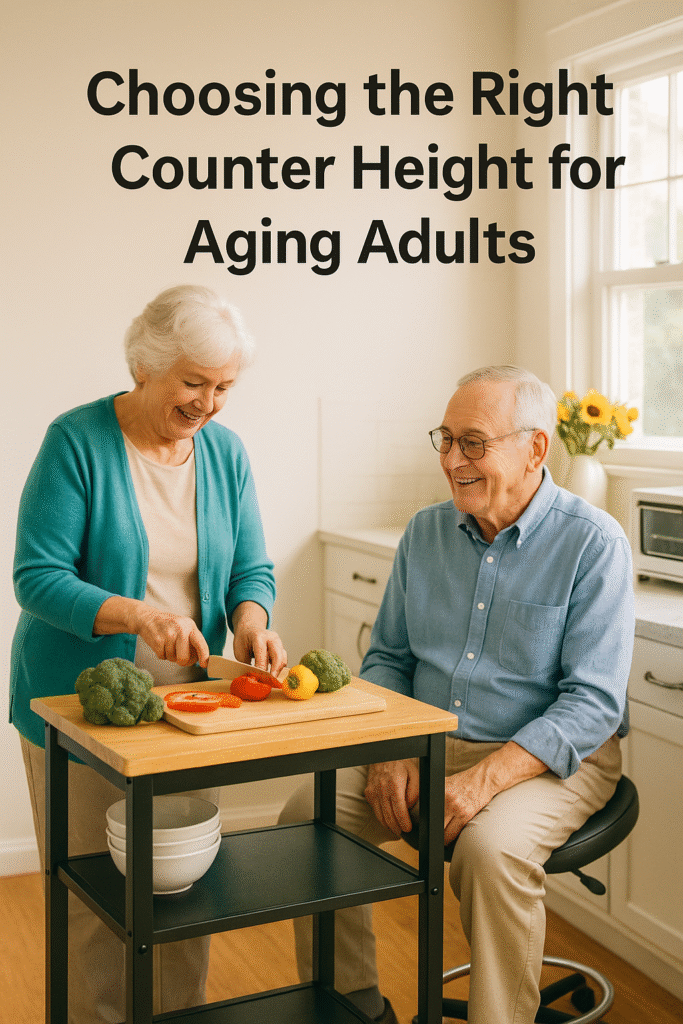
A stable perching stool can reduce fatigue while keeping the cook high enough to see into bowls and pans. Choose a stool with a back or supportive handles, nonslip feet, and a seat height that lets both feet rest securely. Do not use a rolling office chair in a food-preparation area.
For seated or wheelchair use
A seated work surface often falls around 28–34 inches, but knee and toe clearance matter as much as the top height. The user must be able to approach straight on without striking plumbing, cabinet doors, or a hot appliance. A shallow sink, insulated pipes, front-mounted controls, and pull-out boards can improve access. Because wheelchair dimensions and reach vary, an occupational therapist or accessibility professional should review permanent structural changes.
Safe Reach Matters More Than One Perfect Number
A comfortable counter can still be unsafe if the microwave is above shoulder level or heavy cookware lives in a low corner cabinet. Create a primary reach zone for items used every day. Keep plates, lightweight pans, ingredients, and controls where they can be reached without stretching, climbing, or deep bending. Place the heaviest appliance on a fixed surface where it can stay.
- Leave a clear landing area beside the microwave, refrigerator, oven, and sink.
- Use pull-out shelves or drawers instead of reaching into deep lower cabinets.
- Keep electrical cords away from sink edges and walking paths.
- Use bright task lighting that does not create glare on shiny counters.
- Choose a matte, high-contrast cutting board so food and knife edges are easier to see.
Low-Cost Improvements Before a Remodel
A full cabinet replacement is not always necessary. A thick, nonslip cutting board can raise one prep zone. A sturdy lower table can provide a seated station. A pull-out board may add a temporary work surface, provided it is rated for the expected load and cannot retract during use. An anti-fatigue mat may help some standing cooks, but its edges must lie flat and it should be removed if it becomes a trip hazard.
Avoid unstable tray tables, stacked loose boards, and carts whose wheels do not lock. Never lower a cooktop casually: hot cookware, ventilation, clearances, and the position of controls require professional planning.
Counter-Height Trial Checklist
- Can the cook chop for five minutes without lifting the shoulders?
- Can they see into a mixing bowl or pan without leaning?
- Can a hot dish move to a landing space in one short motion?
- Are knees, toes, and wheelchair footrests clear?
- Are outlets, cords, and controls visible and reachable?
- Does the surface remain stable under downward pressure?
- Is there enough light without reflected glare?
If pain, weakness, tremor, or balance changes are significant, ask an occupational therapist to observe a normal cooking task. A short real-world assessment can reveal safer solutions that measurements alone miss.
Frequently Asked Questions
Should every counter be lowered for an older adult?
No. One accessible prep station is often enough, and lowering everything may make standing tasks less comfortable. Test a small work zone first.
What surface is best for kneading or pressing?
A slightly lower, rigid surface usually gives better leverage. The user should be able to apply pressure without raising the shoulders or losing balance.
Can a rolling cart provide a second height?
Yes, if it has a high load rating, a stable top, and wheels that lock securely. Test it empty before placing an appliance or hot dish on it.
Related guide: See our senior kitchen safety checklist before changing the work area.