
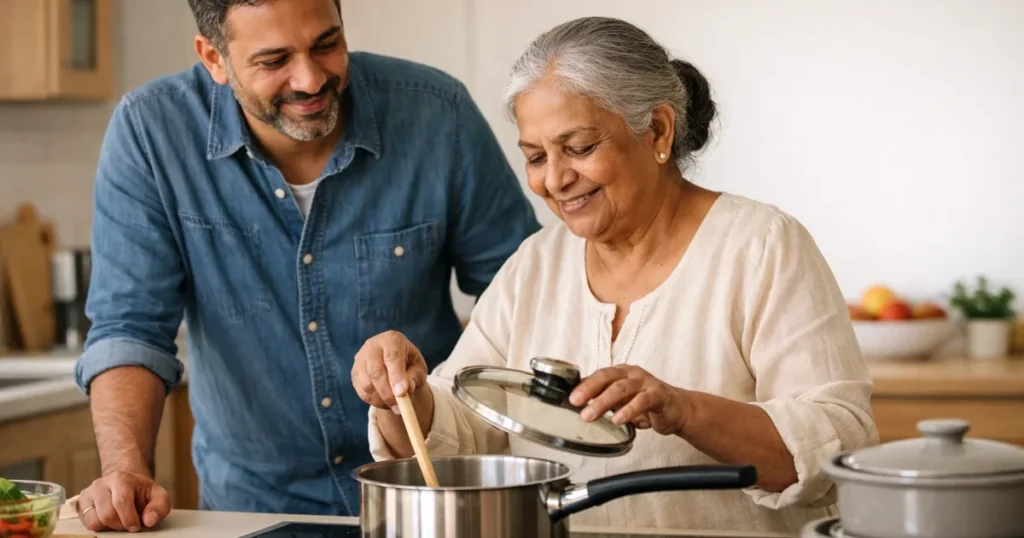
If you are shopping for a parent—or choosing cookware for yourself—what’s the material question is really a handling question. In an elderly kitchen, a pan should feel manageable to lift, steady to hold, and realistic to clean after an ordinary meal. Material matters, but so do the finished pan’s weight, balance, handle shape, lid, and the cooking routine it requires. Check those details on the exact item rather than assuming every pan made from the same material will feel alike.
This guide compares common cookware materials through a practical senior-friendly lens: lifting, grip, heat management, cleanup, and visibility while cooking. The exact products in this article have not been independently confirmed for weight, dimensions, handle design, cleaning instructions, or other model-specific features. Treat the product blocks as purchase options, then verify the current manufacturer instructions and listing details before choosing. The most useful green flags are details you can confirm for the exact piece: a manageable empty weight, a secure-feeling handle, clear care instructions, and a size that fits the cook’s usual meals.
By the end, you will have a practical way to compare materials and the exact questions to ask before buying. The goal is not to declare one material universally safe or easy to use; it is to choose a piece whose weight, grip, care needs, and size suit the person who will use it.
Quick Picks (Senior-Friendly Cookware Materials)
Use these product blocks as a starting point, then confirm the exact pan’s size, weight, handle, lid, compatible cooktop, and care instructions before purchase.


📎Comparison Table: Best Material for Elderly-Friendly Cookware
| Product | Type | Key Features | Why | Buy it now | |
|---|---|---|---|---|---|
| Ceramic Nonstick Fry Pan (Lightweight) | Ceramic Nonstick | • Easy-release surface • Low-effort cleanup • Best on low–medium heat | Safest “daily driver” for seniors—less sticking means less scrubbing and less wrist strain. | ||
| Hard-Anodized Nonstick Skillet | Hard-Anodized Nonstick | • More durable nonstick • Even cooking for simple meals • Quick wipe-clean finish | Easy to use for everyday cooking; helps reduce mess and cleanup time in an elderly kitchen. | ||
| Tri-Ply Stainless Steel Saucepan | Stainless Steel (Tri-Ply) | • No coating to wear off • Stable simmering (soups/oatmeal) • Easy to sanitize | Great long-term “safe & durable” choice if your parent prefers no nonstick coating. | ||
| Stainless Steel Fry Pan | Stainless Steel | • Versatile for many foods • Tough surface (scratch-resistant) • Works well with simple technique | Safe and reliable: once heat is kept moderate, it’s straightforward and long-lasting. | ||
| Steel Bakeware Set (Sheet-Pan Meals) | Steel / Bakeware | • Great for one-pan oven meals • Easy to line with parchment • Less stirring & splatter | Perfect for seniors who want fewer steps—“set & check” cooking can feel safer and calmer. | ||
| Carbon Steel Pan | Carbon Steel / Steel | • Fast heating & responsive • Can become naturally nonstick • Great for quick meals | Good for seniors who want fast cooking; just needs simple care (dry + light oil). | ||
| Ceramic-Coated Cookware | Ceramic-Coated | • Smooth, easy-clean surface • Encourages lower-heat cooking • Gentle everyday use | Low-effort cleanup and calmer cooking—very senior-friendly when used on low–medium heat. |
Detailed Reviews: Senior-Friendly Cookware by Material
When deciding what’s the material that may be most safe and easy to use in an elderly kitchen, begin with the finished piece rather than the label alone. Check its empty weight and balance, whether it can be carried with two hands when full, the handle and lid grip, the care routine, and the manufacturer’s heating guidance. The seven products below are not verified here for those exact-model details, so do not treat a section heading or older product copy as confirmation.
1) Ceramic Nonstick Fry Pan: The Low-Effort “Everyday” Option
A ceramic-coated pan may appeal to a cook who wants a surface intended for lower-effort cleanup, but the care and heating instructions vary by exact model. Before choosing one for an elderly kitchen, confirm the manufacturer’s permitted utensils, cleaning method, and heat guidance. If the cook has sore wrists or reduced grip, also check the pan’s empty weight and whether its handle remains comfortable when the pan contains food.
- Why to consider it: Review the exact model’s care instructions and decide whether its cleanup routine is manageable for the intended cook.
- Cooking tip: Follow the exact pan’s manufacturer heat instructions; begin conservatively and avoid leaving any pan unattended on an active burner.
- Care tip: Use only the utensils and cleaning methods listed in the exact model’s care instructions.
Pros
- May suit cooks who prefer a coating-care routine, if confirmed by the manufacturer
- Check the exact cleaning instructions before relying on a quick-clean routine
- Confirm the manufacturer’s recommended heat range for this exact model
Cons
- Care requirements and expected surface performance must be checked for the exact model
- Confirm whether the manufacturer permits high-heat use before planning searing
Best for: A cook who can confirm that this exact pan’s weight, handle, heating guidance, and care routine fit their needs.
/
— Linda, Phoenix, AZ
2) Hard-Anodized Nonstick Skillet: Durable, Forgiving, and Senior-Friendly
Hard-anodized cookware is a material category, not a guarantee of a particular weight, heating pattern, handle, or coating-care requirement. For an older adult, verify those details for the exact skillet before buying. A more capable model is worth considering only when its confirmed handle, capacity, helper handle, or care instructions solve a real need; a simpler piece can be sufficient when it is easier to lift and maintain.
- Why to consider it: Compare the exact model’s manufacturer instructions, weight, and care requirements with the cook’s routine.
- Easy-to-use tip: Use the exact manufacturer’s heating instructions and keep the pan attended while it is on the burner.
- Care tip: Follow the exact manufacturer’s cleaning instructions; do not assume dishwasher or hand-washing suitability from the material name.
Pros
- Exact-model durability has not been confirmed
- Check the exact model’s coating-care and cleaning instructions
- Compare confirmed weight, grip, and care needs rather than assuming material performance
Cons
- Use only care methods confirmed for the exact model
- Confirm the manufacturer’s high-heat guidance before choosing it for searing
Best for: A frequent cook only after the exact product’s weight, handle, heat guidance, and cleaning routine are confirmed.
/
3) Tri-Ply Stainless Steel Saucepan: A Long-Term, No-Coating Choice
Stainless steel can be worth considering for a cook who prefers an uncoated cooking surface, but construction, weight, and cooking behavior differ across exact models. Do not assume that “tri-ply” confirms a particular heat result or a manageable lifting weight. For soups, oatmeal, rice, or sauces, choose capacity and handle placement that the cook can safely control when the pot is full.
- Why to consider it: An uncoated surface may suit a cook who prefers that care approach, provided the exact pot is manageable when filled.
- Easy-to-use tip: Follow the cookware maker’s instructions for preheating and cooking. If food sticks, let the pan cool enough to handle safely, then use the approved cleaning method rather than forcing a heavy scrub.
- Care tip: Check whether soaking and the chosen cleaner are approved for the exact cookware; use a gentle method that does not require painful force.
Pros
- Exact-model durability and scratch resistance are not confirmed
- Consider capacity, full-pot weight, and two-handed control for liquid-heavy meals
- Cleaning effort depends on the exact model, cooking method, and care instructions
Cons
- Food release and heating behavior should be learned from the exact manufacturer guidance
- Confirm the exact empty weight and assess how it will feel when full
Best for: A cook who prefers an uncoated pot and can safely lift its intended capacity, ideally using two hands when full.
/
4) Stainless Steel Fry Pan: Great for Simple, Classic Cooking (With the Right Technique)

A stainless steel fry pan may suit a cook who prefers an uncoated surface and is comfortable following the maker’s cooking and cleaning instructions. It is not automatically easy to use: confirm the exact pan’s weight, handle, and care requirements, then decide whether that routine feels practical for the person using it.
- Why to consider it: It may fit a cook who prefers an uncoated surface, but suitability depends on the exact pan and the cook’s comfort with its routine.
- Easy-to-use tip: Follow the exact manufacturer’s instructions. Avoid trying to move hot cookware or scrape stuck food with force.
- Care tip: Use only the soaking and cleaning methods approved for the exact pan.
Pros
- Exact-model longevity is not confirmed
- Suitability depends on the cook’s comfort with the manufacturer’s use instructions
- Uncoated surface; confirm all construction and care details for the exact model
Cons
- May require a different cooking and cleaning routine than a coated pan
- Food release depends on the exact pan, heat, ingredients, and technique
Best for: A cook who prefers an uncoated pan and finds the exact item’s weight and care routine manageable.
/
— Mark, Columbus, OH
5) Steel Bakeware Set: The “One-Pan Meal” Shortcut for Safer Cooking

Bakeware can simplify meal preparation for some cooks, but oven use still requires safe reaching, lifting, and placement on a stable heat-safe surface. Before choosing a sheet pan or set for an elderly kitchen, confirm its dimensions, empty weight, edge shape, and whether the intended cook can remove it safely with appropriate oven mitts. Avoid treating oven cooking as automatically safer than stovetop cooking.
- Why to consider it: It may reduce active stovetop steps for some meals, while adding oven-lifting and hot-surface considerations.
- Easy-to-use tip: Use liners only when they are appropriate for the recipe and oven temperature, and follow the liner and cookware instructions.
- Care tip: Let cookware cool in a safe location and follow the exact manufacturer’s washing instructions.
Pros
- May suit oven meals if the cook can safely handle the exact pan and its load
- Cleanup depends on the recipe, liner instructions, and the exact pan’s care guidance
- May reduce stirring, but a loaded hot sheet pan still requires controlled lifting
Cons
- Oven use requires a clear path, a stable landing surface, and mitts that the cook can grip confidently
- Some seniors prefer stovetop cooking habits
Best for: A cook who can safely manage the exact pan’s size and hot weight and prefers oven-based meals.
/
6) Carbon Steel Pan: Fast Heating, Lighter Feel (With Simple Maintenance)

Carbon steel requires an ongoing care routine, but the exact weight, handle design, factory seasoning status, and care instructions must be confirmed for each model. It should not be assumed to be lighter than another cookware option. Consider it only if the intended cook is comfortable with the manufacturer’s maintenance directions and can safely handle the pan.
- Why to consider it: It may suit a cook willing to follow its specific heating and maintenance instructions.
- Care tip: Follow the exact manufacturer’s washing, drying, and seasoning instructions; do not assume the same routine applies to every carbon-steel pan.
- Senior tip: Confirm the exact product’s guidance for acidic foods and seasoning before planning meals around it.
Pros
- Confirm the exact pan’s heating guidance and decide whether its response suits the cook
- Seasoning performance and care requirements must be confirmed for the exact model
- Compare the exact empty weights; material alone does not establish lifting effort
Cons
- May require model-specific maintenance; verify the manufacturer instructions
- The required cleaning and maintenance routine may not suit every cook
Best for: A cook who is comfortable with the exact model’s verified maintenance routine and can manage its weight.
/
7) Ceramic-Coated Cookware: Gentle Cooking for Lower-Heat Habits

Ceramic-coated cookware may be worth comparing when easy cleanup is a priority, but the exact model’s coating, permitted heat, utensils, and washing method need verification. Do not assume it will reduce smoke, splatter, or effort. The simplest day-to-day option is the one whose confirmed weight, grip, and care instructions the intended cook can follow comfortably.
- Why to consider it: Compare its confirmed care routine and handling details with the cook’s needs.
- Easy-to-use tip: Follow the exact manufacturer’s instructions for preheating and heat.
- Care tip: Use only the cleaning tools and methods permitted for the exact product.
Pros
- Confirm the exact model’s cleaning requirements
- Confirm the manufacturer’s intended use and heat guidance
- Safe use depends on attentive cooking and the exact manufacturer instructions
Cons
- Expected service life and care needs are not confirmed for this exact model
- Confirm high-heat suitability with the exact manufacturer
Best for: A cook who confirms the exact item’s weight, handle, heat guidance, and care routine are manageable.
/
— Patricia, Tampa, FL
Buying Guide: How to Choose Safe, Easy-to-Use Cookware for Seniors
If you are still deciding what’s the material that fits an elderly kitchen, choose by confirmed handling details rather than broad material promises. A safe and easy to use choice is one the person can lift, control, clean, and store without strain. If possible, compare a similar-size empty pan in person before ordering; otherwise, review the exact product’s dimensions, weight, handle, lid, and care instructions.
1) Start with weight and balance (not just size)
- Lighter is not always better: a pan can be light but poorly balanced, and a pan becomes much heavier when filled.
- If evaluating in person, lift the empty pan as it would be used and assess whether the handle, balance, and reach feel controlled. Do not assume one-hand lifting is appropriate for a full pan.
- For a parent with arthritis or limited grip, consider whether the exact piece has a second gripping point and whether two-handed lifting is practical. Use two hands for a loaded pot whenever possible.
2) Handles matter more than most people think
- Check whether the handle shape, thickness, and texture feel comfortable and controllable for the intended user.
- Look for a handle that feels secure when dry and when using a potholder; verify any grip or heat-resistance claim for the exact model.
- For hand tremor or reduced strength, prioritize a controlled, comfortable grip and a safe path from stove to counter. Handle length alone does not guarantee control.
3) Easiest-to-clean usually wins for seniors
- For many older adults, the best option is one that can be cleaned without prolonged gripping, heavy scraping, or awkward lifting at the sink.
- A coated surface may fit a cook seeking an easier cleanup routine, but check the exact product’s approved utensils, heat limits, and washing instructions.
- For stainless steel, review the maker’s cleaning instructions and choose a size that can be soaked, rinsed, and dried without uncomfortable handling.
4) Heat control = safety
- Use the cookware only on a compatible heat source and follow its instructions. Attentive cooking, a clear work area, and avoiding unattended burners are more reliable safety steps than assuming a material will prevent scorching.
- Choose cookware whose manufacturer heat guidance the intended cook can follow confidently; do not assume a heat range from its material.
- If giving cookware as a gift, include the exact care booklet or a clear note to review the manufacturer’s use, cleaning, and compatible-cooktop instructions together.
5) Lid style and visibility help in an elderly kitchen
- A transparent lid can make food easier to see, but verify that the exact cookware includes one and that its knob and lid weight are manageable.
- Check that the lid knob or handle can be gripped comfortably with a dry hand and an oven mitt.
- Keep hands and face clear when opening any hot lid, lifting the far edge first so steam vents away from the body.
6) Material quick match (easy decision rules)
- Want lower-effort cleanup: Compare the exact coated products’ confirmed care instructions, utensil requirements, and weight.
- Want an uncoated cooking surface: Compare exact stainless steel pieces for weight, handle comfort, and cleaning routine.
- Considering carbon steel: Confirm the exact pan’s weight and maintenance requirements, then decide whether that routine is realistic.
- Considering sheet-pan meals: Confirm the pan’s weight and dimensions and plan for safe oven removal and a stable landing surface.
Senior-Safe Cookware Checklist (Quick Scan)
- ☐ Confirmed comfortable, controlled handle for the intended user
- ☐ Confirmed manageable empty weight and a safe plan for lifting it when full
- ☐ Care instructions that do not require painful or difficult cleanup
- ☐ Manufacturer heat guidance the cook can follow
- ☐ Lid, if included, is manageable and can be opened away from escaping steam
Tip: If your parent also needs safer hot-water handling (tea/coffee), link them to a guide on auto-shutoff kettles. See: Best Electric Kettles with Auto Shutoff for Seniors
FAQ: Elderly-Friendly Cookware Materials
1) What’s the safest cookware material for seniors?
There is no universally safest cookware material for seniors. “Safe” is better assessed through the exact item’s manageable weight, secure grip, stable balance, compatible cooktop, clear care instructions, and the cook’s ability to use it attentively. A coated or uncoated surface can both be reasonable choices when those details fit the person and are confirmed for the exact model.
2) Is ceramic nonstick safer than traditional nonstick?
Ceramic-coated and other nonstick cookware should be compared using the exact manufacturer’s instructions rather than broad safety claims. Check permitted heat, utensils, cleaning, and replacement guidance. Whatever the material, do not leave cookware unattended, avoid handling a pan beyond the user’s strength, and follow the instructions supplied with that exact item.
3) What cookware material is easiest to clean for older adults?
The easiest material to clean depends on the exact cookware, recipe, and care instructions. Before buying, check whether the manufacturer permits soaking, dishwashing, particular tools, or liners. For someone with painful hands, the key question is whether routine cleanup can be done without forceful scraping or holding a heavy piece under the faucet.
4) Should seniors avoid cast iron?
Seniors do not automatically need to avoid cast iron, but the exact piece’s empty and full weight should be considered carefully. Do not assume carbon steel is lighter without comparing the specific products. If a pan is difficult to lift empty, it is unlikely to be appropriate when hot and full; use two hands for loaded cookware and choose a smaller capacity when that better fits the user.
5) Does stainless steel cookware stick too much for seniors?
Stainless steel cooking and cleanup can feel different from a coated pan. Review the exact manufacturer instructions and decide whether that learning and cleaning routine is comfortable for the user. If the priority is minimal technique and cleanup effort, compare the confirmed care requirements of the available coated options rather than assuming one will be easier.
6) What’s the best cookware material for seniors with arthritis?
For arthritis, choose cookware based on confirmed handling details: empty weight, balance, handle shape, lid grip, and cleaning demands. A helper handle can be useful when it gives the cook a stable second point of contact, but it does not make an overly heavy pan appropriate. Consider a smaller pan or pot if the full capacity would be difficult to move safely.
7) How do I make any cookware safer for an elderly kitchen?
Make any cookware safer by keeping a clear route between stove, oven, and counter; using a stable heat-safe landing surface; checking that mitts allow a secure grip; and avoiding lifts that feel uncertain. Start with a small set of pieces that match the cook’s usual meals. Follow each item’s manufacturer guidance instead of relying on a single heat rule for every material.
Conclusion: So, What’s the Best Material for Elderly-Friendly Cookware?
The best answer to what’s the material question depends on the user’s daily routine and the exact cookware, not on a material label alone. A coated option may be worth considering when its confirmed care routine reduces cleanup effort. Stainless steel may suit someone who prefers an uncoated surface and can manage the exact pot or pan. Carbon steel may suit someone willing to follow its verified maintenance instructions. In every case, compare the actual weight, balance, grip, capacity, and care requirements before deciding.
If you are buying a gift, begin with the recipient’s usual meals and kitchen space. One skillet and one pot may be sufficient, but confirm the exact pieces are manageable to lift, work on the recipient’s cooktop, and fit their storage. If timing matters, ask the buyer to confirm current availability and estimated delivery on Amazon; do not assume stock or arrival dates.
Best “Easy Daily Use” Pick (Great for Seniors)
Before selecting the product below, confirm its current exact-model specifications, care instructions, size, weight, handle design, and compatibility with the intended cooktop.
Need more senior-friendly cookware ideas? Compare exact handling and care details before adding another piece.