
Best Touchscreen vs Knob Microwaves for Seniors (2026): Which Is Easiest to Use?
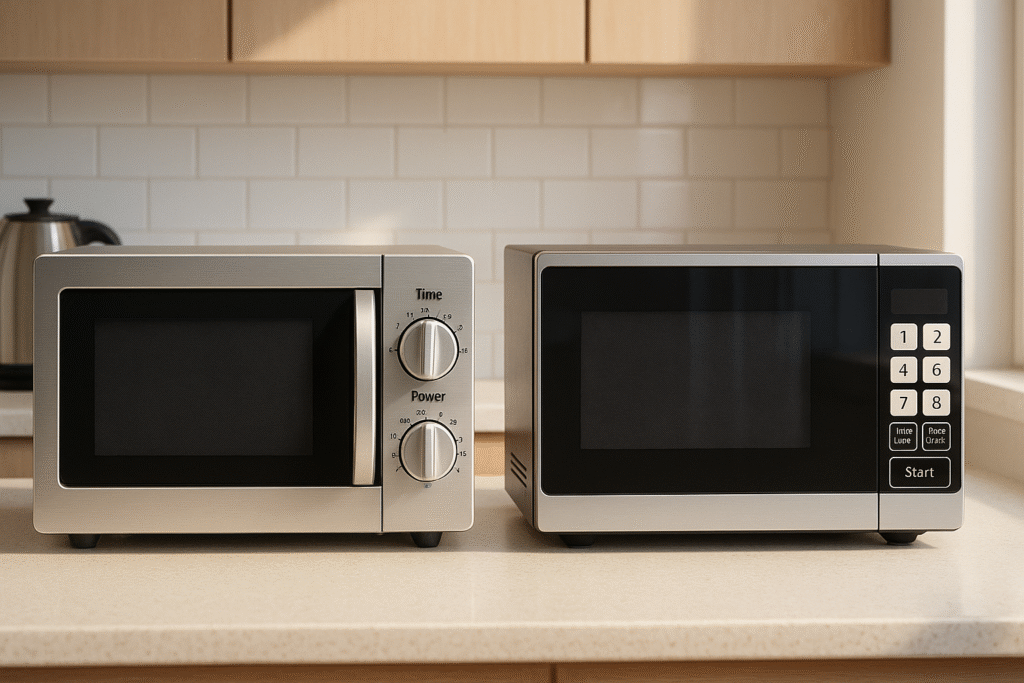
Choosing touchscreen vs knob microwaves for seniors starts with an ordinary task: can the intended user open the door, place a familiar bowl inside, select a short heating cycle, and stop it comfortably? A control style alone does not establish that a microwave is easy to use. A dial may be easy to locate but difficult to turn; a touchpad may have readable numbers but require an awkward press. Compare the exact appliance with the person who will use it. If you are buying for a parent, include them in the decision instead of assuming that newer controls or fewer buttons will suit them better.
This guide compares the practical questions behind both designs: reading labels, selecting time and power, opening the door, hearing or seeing completion cues, and cleaning around the controls. Touchscreen and touchpad are not interchangeable terms. A screen can present changing menus, while a printed touchpad may keep the same keys in the same places. Product names can also describe controls loosely. Check photographs and the exact-model manual before choosing. Our existing product displays remain below for comparison; the surrounding advice is research-based buying guidance, not a report of hands-on testing or a promise that every listed model has every feature discussed.
Start by writing down the meals the microwave will handle, the dish normally used, and the place where that hot dish will be set down. Then compare the steps required by each candidate. Treat a product shortlist as the beginning of that comparison, and check current specifications and availability on the exact listing before purchase. As an Amazon Associate I earn from qualifying purchases.
Quick Picks: Easiest Microwaves for Seniors
Use these existing product cards as starting points for comparing control layouts. Before selecting a model, confirm the exact control panel, door operation, installation instructions, and alert settings for the variant being sold. A short route from choosing a cooking time to stopping a cycle matters more than the number of advertised programs. Keep the recipient's usual bowl and counter location in mind while comparing.

- Check button size and contrast
- Compare the everyday control sequence
- Confirm fit for the intended user

- Check labels in normal lighting
- Follow exact-model heating instructions
- Review the documented cleaning routine

- Compare time and power selection
- Check the timer markings
- Assess handle and door movement
📎Comparison Table: Best Touchscreen vs Knob Microwaves for Seniors
| Product | Type | Key Features | Why | Buy it now |
|---|---|---|---|---|
| Toshiba EM131A5C-BS 1.2 cu ft Microwave (Smart Sensor) | Touchscreen / Touchpad | Big buttons; clear labels; one-touch start; bright display; easy presets | Great “everyday” pick for seniors who want large, readable controls and simple reheats | |
| Senior-Friendly Touchpad Microwave (0.9–1.1 cu ft) | Touchscreen / Touchpad | Legible keypad; express-cook keys; interior light; easy-clean faceplate | Straightforward for those who prefer labeled buttons over dials | |
| Large-Button Touchpad Microwave (Easy-Clean Front) | Touchscreen / Touchpad | Simple keypad; large digits; quick-start; clear on-screen cues | Good fit when vision needs larger text and obvious feedback | |
| Simple Two-Knob Microwave (Time & Power) | Knob (Mechanical Dials) | Two dials: time & power; clicky tactile feedback; no confusing menus | Best for arthritis/tremors—grippy dials are easier than tiny buttons | |
| Panasonic NE-1025F Dial Microwave (Commercial 1000W) | Knob (Mechanical Dials) | Big dial timer; sturdy handle; bright interior light; easy to wipe | Ideal when you want ultra-simple “turn-to-time” use and long life | |
| Icon-Driven Touchscreen Microwave (Quick Presets) | Touchscreen / Touchpad | Big icons; one-touch programs; flat front for easy cleaning; clear countdown | Great for seniors who like visual icons and minimal steps | |
| Compact Easy-Use Microwave with Express Cook | Touchscreen / Touchpad | Readable clock; express cook; easy door handle; compact footprint | Good for small kitchens that still need simple, reliable controls |
Touchscreen vs Knob Microwaves: Detailed Reviews
Toshiba EM131A5C-BS 1.2 cu ft Microwave (Smart Sensor)
For the Toshiba EM131A5C-BS, begin with the exact control panel rather than the number of programs in its description. Identify the everyday start, stop, time, and power controls in the current manual. If preset reheating is important, check what the preset actually does and how to interrupt it. A household can then practise one familiar task together, using the appliance instructions. Do not assume that a sensor setting eliminates the need to check food or that a large display guarantees readable labels around the keys. The useful question is whether the complete routine feels comfortable to the intended user.
Pros
- Check contrast across the whole panel
- Confirm preset operation in the manual
- Compare start and cancellation steps
- Check available sound settings
Cons
- Assess reflections in normal lighting
- Allow time to learn unfamiliar controls
- Measure installation space and clearances
Best for…
- Users who can read the panel comfortably
- Households checking a repeatable reheating routine
- People sharing the same appliance instructions
Senior-Friendly Touchpad Microwave (0.9–1.1 cu ft)
A compact touchpad format deserves particular attention to the relationship between the cavity, door opening, and the dish someone normally carries. A small external footprint does not establish that a bowl fits comfortably or that the controls are easy to read. Check the exact dimensions and ventilation instructions before deciding where the appliance will sit. Next, locate the controls used for ordinary reheating and cancellation. If the intended user dislikes repeated button presses, compare the documented quick-start sequence with the alternatives. The existing product display identifies the item; confirm its current exact-model details before relying on a feature mentioned in older copy.
Pros
- Check documented express-cook shortcuts
- Review lighting and cleaning instructions
- Assess the door release and handle
Cons
- Check the usual dish fits
- Recheck timings against the appliance instructions
- Confirm sound options for the exact variant
Best for…
- Buyers measuring a limited counter location
- Users comparing fixed labels with dials
- Households comparing a simple daily routine
Large-Button Touchpad Microwave (Easy-Clean Front)
When comparing a model presented as a large-button microwave, separate three things: the size of the time display, the size of the printed key labels, and the force or gesture needed to operate the keys. A photograph of large digits does not establish that every button is readable. Consider reflections in the kitchen's usual lighting and whether the user can locate stop or cancel promptly. Ask how time is adjusted after a cycle has started. A clear correction path can be as useful as a convenient starting sequence, particularly in a shared kitchen where several people use different settings.
Pros
- Check display and label readability separately
- Locate the everyday start and cancel controls
- Review exact-model care instructions
Cons
- Check the required pressing action
- Assess display visibility in normal lighting
- Additional programs may need familiarisation
Best for…
- Users who can read the actual panel
- People checking the complete cleaning routine
- Households comparing familiar reheating tasks
Simple Two-Knob Microwave (Time & Power)
For a two-knob design, compare the work each dial actually performs. Check how time and power are labelled, whether the pointer position is clear, and what the manual says about stopping a cycle. A large knob is not automatically a comfortable knob: the person still needs a manageable grip and turning action. Where practical, assess the control with the intended user before committing to a purchase. Think about a short reheat as well as a longer task, because selecting a small interval may feel different from setting several minutes. Simplicity should describe a workable routine rather than a promise made from appearance alone.
Pros
- Check grip and turning effort
- Confirm how time and power are selected
- Compare a complete reheating sequence
Cons
- Check timer markings and available precision
- Confirm which settings the model provides
- Use the documented heating instructions
Best for…
- Users who find the actual dials comfortable
- Households preferring a consistent documented routine
- People comparing simple controls for shared use
Panasonic NE-1025F Dial Microwave (Commercial 1000W)

For the Panasonic NE-1025F, check the exact-model documentation and intended installation before comparing it with a household microwave. A commercial label does not establish that the controls, counter location, cleaning routine, or service arrangements suit a private home. Find the documented way to set and cancel time, and consider whether everyone using the appliance understands it. Account for setup and moving assistance when choosing a location. If the design does not use a turntable, confirm how the manufacturer instructs owners to load and clean it; do not infer heating performance or maintenance needs from that feature alone.
Pros
- Assess the actual timer dial
- Confirm cavity arrangement in the manual
- Use exact-model instructions for operation
Cons
- Arrange suitable placement and setup assistance
- Check available functions before choosing
- Confirm suitability for the intended setting
Best for…
- Buyers reviewing intended-use and installation requirements
- Users who find the dial manageable
- Households able to follow the documented routine
Icon-Driven Touchscreen Microwave (Quick Presets)
An icon-driven interface can be appealing when the symbols are familiar, but the user still needs to understand what each one selects and what happens next. Check whether the exact appliance uses a changing touchscreen, a fixed touchpad, or a combination. Compare a normal reheating sequence with a mistake-correction sequence: can the person cancel, change the setting, and return to the starting point? Look for the instructions behind any claim about presets, alert volume, or cleaning. A modern appearance is useful only if the everyday controls and feedback fit the household's actual habits.
Pros
- Check the meaning of each icon
- Confirm visible status and cancellation feedback
- Review cleaning instructions for the panel
Cons
- Symbols may need familiarisation
- Assess reflections in normal lighting
- Verify available alert settings
Best for…
- Users who understand the displayed symbols
- Families practising the same documented routine
- People assessing appearance alongside practical operation
Compact Easy-Use Microwave with Express Cook

For a compact express-cook option, confirm which shortcuts the exact variant provides and whether they can be adjusted or cancelled in a straightforward way. The number of steps is only part of usability. The door must open comfortably, the dish must fit, and there must be a reachable place for the hot container. Check labels under normal lighting rather than judging them only from a bright product photograph. If a family member is helping with setup, walk through one familiar meal and leave a short, accurate reminder based on the manual. Extra programs need not be part of that daily routine.
Pros
- Confirm the documented shortcut sequence
- Assess door movement and grip
- Measure the complete installation footprint
Cons
- Check that everyday dishes fit comfortably
- Follow the exact-model timing instructions
- Check actual label readability
Best for…
- Households comparing familiar portion sizes
- Buyers measuring a limited counter location
- Users who find the full routine manageable
Buying Guide: Touchscreen vs Knob Microwaves for Seniors
Use this checklist to compare the entire task rather than voting for a control style in the abstract. Write down any non-negotiable needs, such as readable cancellation controls, a comfortable door, or an alert the user can notice. Then use the exact-model manual and, where available, a demonstration to check them. Features can differ between apparently similar versions. Keep a record of the model number so a helpful instruction for one appliance is not accidentally applied to another.
1) Hand strength & dexterity
- Knobs: check grip, turning effort, pointer visibility, and the spacing between settings. A person who prefers tactile controls may still find a particular dial uncomfortable. Include the intended user in the assessment where possible, and compare an ordinary time-setting task rather than assuming a knob solves every hand-control difficulty.
- Touchscreen/Touchpad: distinguish a changing screen from fixed labelled keys. Check the size and contrast of the controls the person actually uses, the pressing action, and the steps required to cancel or correct a setting. A simple printed panel may be preferable to menus for some users, while others may prefer its alternatives.
2) Vision comfort
- Check the display and the printed labels separately in the kitchen's normal lighting. Look for reflections and confirm that the user can read time, power, and cancellation controls from their usual position. A bright display does not establish that the rest of the panel is equally readable.
- Check the meaning of each preset the household plans to use. An icon or short label should lead to an understandable result, and the instructions should explain any additional choices. There is no need to learn every program immediately; begin with the routine that matters most.
3) Hearing & beep volume
- If sound matters, look for a documented sound setting for the exact variant. Check whether it changes button tones, completion alerts, or both. Do not infer a mute option from the control style, and consider whether silencing an alert would remove a reminder the intended user relies on.
- Ask the intended user how they prefer to notice that a cycle has finished. An audible cue, a visible countdown, and a written routine serve different purposes. Check the model documentation rather than assuming a dial appliance is silent or that a touchpad provides adjustable volume.
4) Cognitive load (memory, multi-step tasks)
- For a knob model, follow the exact instructions for setting power, selecting time, and stopping a cycle. Designs differ. Avoid assuming that closing the door, turning a dial, or pressing an unrelated control works the same way as a microwave previously used in the home.
- For a touchpad model, confirm the documented short sequence for a familiar task and the way to cancel it. Count the required actions, including any confirmation step. A shortcut is helpful when its result is clear to the user, rather than simply because it appears on the panel.
5) Safety features
- Door and handle: assess the actual opening movement, grip, and clearance. A pull handle and a push-button release can each be comfortable or awkward depending on the appliance and user. Leave room for the door to open without forcing an awkward reach around nearby objects.
- Control lock: check whether the exact model provides one, what it locks, and how it is released. A lock feature does not replace supervision where help is needed. Ensure the normal user and anyone assisting them can understand its status without relying on guesswork.
- Interior visibility: consider the user's view into the cavity and the readability of the display from the planned location. Check the documented lighting behaviour for the exact appliance. Being able to see a dish is useful, but appearance alone does not establish that food is heated appropriately.
6) Size, wattage & placement
- Capacity: compare the actual usable space, turntable or floor arrangement, and door opening with the usual dish. The stated cavity capacity alone does not answer whether that dish fits or is comfortable to remove. Check both the internal arrangement and the appliance's external placement requirements.
- Wattage: use the appliance manual and food instructions when planning a reheating routine. A power rating alone does not establish a universally suitable microwave for seniors. Compare the controls and adjustment method as well, and do not transfer a cooking time from an old appliance without checking it.
- Placement: choose a stable location that meets the manufacturer's installation and ventilation requirements and permits a comfortable reach. Plan a nearby landing space for the hot dish. Consider both removing food and cleaning the appliance; a location that looks tidy may still make those tasks awkward.
7) Cleaning & maintenance
- Follow the exact-model cleaning instructions, including any restrictions around controls, vents, seals, and the cavity. Compare how the user will reach the areas that need attention. A flat front or simple dial does not by itself establish that every part is easy to clean.
- Check care instructions for any turntable, tray, or other removable part before washing it. The absence of a turntable changes the arrangement of the cavity but does not remove the need to follow the appliance's cleaning directions. Plan cleaning access when choosing the counter location.
Quick pick by need
- Easiest overall touchpad: Toshiba EM131A5C-BS — big digits, sensor reheat.
- Simplest knobs (home use): Two-dial time & power—fast learning.
- Rugged & easy to wipe: Commercial dial with no turntable.
FAQ: Touchscreen vs Knob Microwaves for Seniors
1) Which control style is safer for seniors?
Neither control style establishes safety by itself. Compare the user's ability to select and stop a cycle, open the door, handle the dish, and understand the instructions. The appropriate choice is the exact appliance that supports a manageable routine and fits its intended installation, with assistance where needed.
2) Are knobs better for arthritis or tremors?
Not automatically. Compare a particular dial's grip and turning action with a particular panel's pressing action. Preferences and practical needs differ. Where possible, involve the person in trying the controls and checking cancellation before choosing. Avoid treating a large knob as a guarantee of comfortable use.
3) What wattage is best?
There is no single wattage that answers every senior user's needs. Consider the foods normally prepared and use the appliance and food instructions to establish a repeatable routine. Readability, door operation, placement, and clear time and power adjustment also matter; a larger power rating does not settle those questions.
4) Can I mute the beeps?
Only if the exact model and variant provide that setting. Check the manual for sound, mute, or alert instructions and confirm which sounds the setting affects. Consider the user's reminder needs before changing it. Do not assume the feature exists because another appliance from the same brand has it.
5) What size should I get for a small kitchen?
Measure the planned location and compare the exact external dimensions, required ventilation space, door swing, and the dish normally used. Leave a useful landing space nearby. A small cavity or a compact label does not establish the full installation footprint, and a snug fit can still be inconvenient to use.
6) Is an inverter microwave necessary?
It is a feature to evaluate rather than a universal requirement. Read the exact model's explanation and operating instructions, then consider whether it helps the household's usual tasks. Do not choose on that term alone; the control sequence, comfortable handling, and appropriate placement still need to work for the intended user.
7) Are commercial dial microwaves too powerful?
A commercial design should be assessed against its exact instructions and intended setting. Check installation, normal operation, cleaning, and support arrangements before using it in a home. Do not assume that a simple timer makes every task straightforward or that another microwave's timings apply. Compare the complete routine with household alternatives.
Conclusion: Pick the Control Style That Feels Natural
Choose the control style after checking the daily task with the person who will use it. Knobs may appeal to someone who prefers turning a control, while a clearly labelled touchpad may suit another person's familiar routine. Confirm the exact model and variant, installation needs, door operation, cancellation, and cleaning instructions. For a gift, arrange setup and a short practice session rather than handing over an unfamiliar appliance without context. Keep the existing product cards as comparison points, and choose only after their current details match the needs you have identified.